Showing posts with label Manyara Region Travel. Show all posts

Saturday, June 27, 2020

Maramboi Tented Camp

Sunset over the flooded surroundings
Maramboi Tented Camp has one of my favorite surroundings of any lodge in the north, especially for a lodge outside of a national park. Mamramboi Tented camp sits on the eastern side of Lake Manyara (Lake Manyara National Park is on the western side of the lake). The lodge is situated in a Wildlife Management Area (WMA), one of several community run conservation protected areas in Tanzania.

Maramboi is a massive tented camp far less intimate than many other tented camps. It has over 40 rooms (most tented camps have less than 15) and serves more or less as an appetizer for other camps on safari. Most safari goers will stay here their first day of safari on their way from Arusha en route to Serengeti National Park. As a result most of the guests are only staying one night and they come in the evening with a quick turn around to be out in the morning. Thus some of the intimacy and attention to detail isn't quite as apparent in this lodge as others but it avoids feeling like an empty big box lodge/hotel.

The best thing Maramboi has is its setting. Normally it is set in a grassland with views of Lake Manyara but the massive rains this year have flooded the area right up to the lodges. Waterbirds are numerous and wildebeest and zebra graze right outside the tents. We've visited when the waters are lower and the shoreline is kilometers away and it's still quite beautiful. For us residents we still must pay a WMA fee but they're far less expensive than the national park fees. The lodging is far superior and better value than anything you'd find in the park with the only downside being it can feel quite crowded. However, for those in Arusha it makes a perfect weekend getaway.

The pool looking out into the lake.

Totally flooded

Wildlife from our balcony


Saturday, December 22, 2018

Tarangire National Park: Trip V

Friendly elephants
It had been almost a year since we had visited Tarangire National Park (Trip IV) and we were excited to visit the north after some time away. We had remembered Tarangire for being a paradise for birds and elephants and we were not disappointed!


Beautiful campsite

Sunrise over the Silale Swamp

We arrive to Tarangire National Park around noon and were shocked at the amount of safari cars waiting to enter. We've gotten used to the non existent queues in Ruaha National Park and seeing nearly 40 safari vehicles was a shock to the system. However, this meant they were much more efficient at getting people registered and paid for and we quickly paid for our entry and special campsite. Quick side rant; camping in the park is an already expensive $30 per person and camping at a special campsite is $50 per person. The irony of this is that a special campsite literally means there is nothing but a clearing; no water points, toilet, etc. So in turn you are actually paying a ridiculous amount for absolutely zero services, it doesn't make sense! But we were willing to splurge since we assumed the public campsite (which do actually have services available) would be crowded during the holiday time and we wanted to camp in the middle of the park by the Silale Swamp.

After getting into the park we drove about 10 minutes and in the distance we saw a group of about 10 safari cars. Some seemed to be moving and jockying for space but it was obvious they were looking at something. We got excited and thought it was perhaps a cheetah hunt or some lions. We raced ahead and had to laugh at ourselves when we realized they were all taking pictures of a troop of baboons. One thing to note is that several tour operators have a "standard safari" which starts in Tarangire. As a result, the majority of the people in Tarangire are on their first day of safari and thus eager to stop for any wildlife, even distant giraffes or zebras that they can barely see. This was on full display in this instance as baboons are numerous and actually a nuisance at several of the picnic areas. But I remember MY first baboon, and it was exciting, so we just waved at the group of cars and passed by.

We had a wonderful day in the park that included several elephants within 5m of our car, tons of birds, and an unexpected car break down. The bumpy road had broken the wiring to our fuel pump but we were saved by a group of workers from the park. They helped us diagnose and fix the problem and in a very Tanzanian way were insistent that they did it not for money but because everyone needs to help each other in the bush. They were a chatty and fun group and even knew one of our co-workers from when they conducted an internship at the park. This incident happened late in the afternoon and we ended up making it to our campsite late in the evening.

The campsite was completely empty and far from anyone else. We set up camp under a tree, lit a fire, and began to prepare dinner. I was unloading stuff from the car and Ana was cooking when I wandered over to the fire. We had been speculating if a storm was going to hit us and Ana had her head down chopping veggies when she said, "I think we're gonna get hit". This was aptly timed with a buffalo that had strolled into our campsite not 15m in front of Ana. My brain registered that she was talking about the buffalo, a very uncharacteristic nonchalance from Ana. I shouted to her and she immediately shot up and ran to the car. Luckily we have some noisemakers in our car and we scared off two buffalo that were a bit to close for comfort.

We did not get hit by the storm and packed up early the next morning to explore the swamp. It was a beautiful morning and part of the benefit of camping deep inside the park is having the place to yourself in the morning. We tracked some lion and hyena footprints, did some birdwatching, and enjoyed the beautiful sunrise over the swamp before heading out of the park.


Saturday, March 25, 2017

Lake Manyara National Park: Trip II

Ana taking in the views of flamingos. 
I never want to take our proximity to world-class nature areas for granted, so this weekend we made the big trip to Lake Manyara (Trip I). While possible to do in a weekend, it does require a big effort driving. We left Moshi at 5pm on Friday and arrived to a small town just outside the park at around 830pm. We had actually planned to stop earlier and stay somewhere a half hour away but the guesthouse we like was uncharacteristically full. We did stop there and check and after hearing it was booked we decided we might as well eat dinner before heading on. Luckily the town outside the park has about a million guesthouses so we chose a decent one and went to sleep.

In the morning we had a nice breakfast of chapati, fried egg, and coffee. We checked into the park at 8am and began exploring the park. One of the cool things about Manarya is that it contains multiple ecological zones due to its skinny north/south orientation and the fact that it is neatly tucked between the massive Lake Manyara and the towering and escarpment of the Great Rift. You can always see one or both of these features from where you are in the park.

When you first start you weave through a jungle-like groundwater forest, which is a stark contrast to the grassland and dry acacia that dominates the landscape on the drive to the park. The landscape then breaks open into grassland bordering the lake, and a nice little road network allows you to drive through some puddles and flooded areas to reach a viewing platform.

The actual lake isn't so easy to view from the northern part of the park, but as bird watchers there is more than enough to keep us busy. The landscape is also impressive no matter what direction you are facing. We spent 2-3 hours in the first bit of the park just enjoying the birds and buffalo and wildebeest roaming about.

We then headed south through the acacia woodland, though there wasn't much to see as the heat of the day came on. We wanted to reach the mid-way point of the park where there is a campsite and accessible roads to the shoreline. Most of the lake shore is a strange contrast to the swamp north as it's dry with cracked mud and a very desolate looking feel.

When we reached the campsite we were absolutely enamored by the landscape. It felt a bit like Lake Natron to us and the distance and isolation felt massive. We could see thousands of flamingos and hear their incessant chatter as they fed. The sky felt huge, the lake endless, and the escarpment towered over us on one sid; it was truly a beautiful area and moment!

We thought our adventure was over as we planned to drive straight out of the park. But on our way back we saw a lone elephant a few meters from our car. What happened next was the closest and scariest elephant encounter we've had!

Zebras taking a stroll. 

Flashflood river bed. 

Calm lake. 

The lake with the rift valley is a very impressive sight. 

Elephant doing its thing. 

Sunday, March 12, 2017

Blue Mountains

Taking a break to take in the view. 
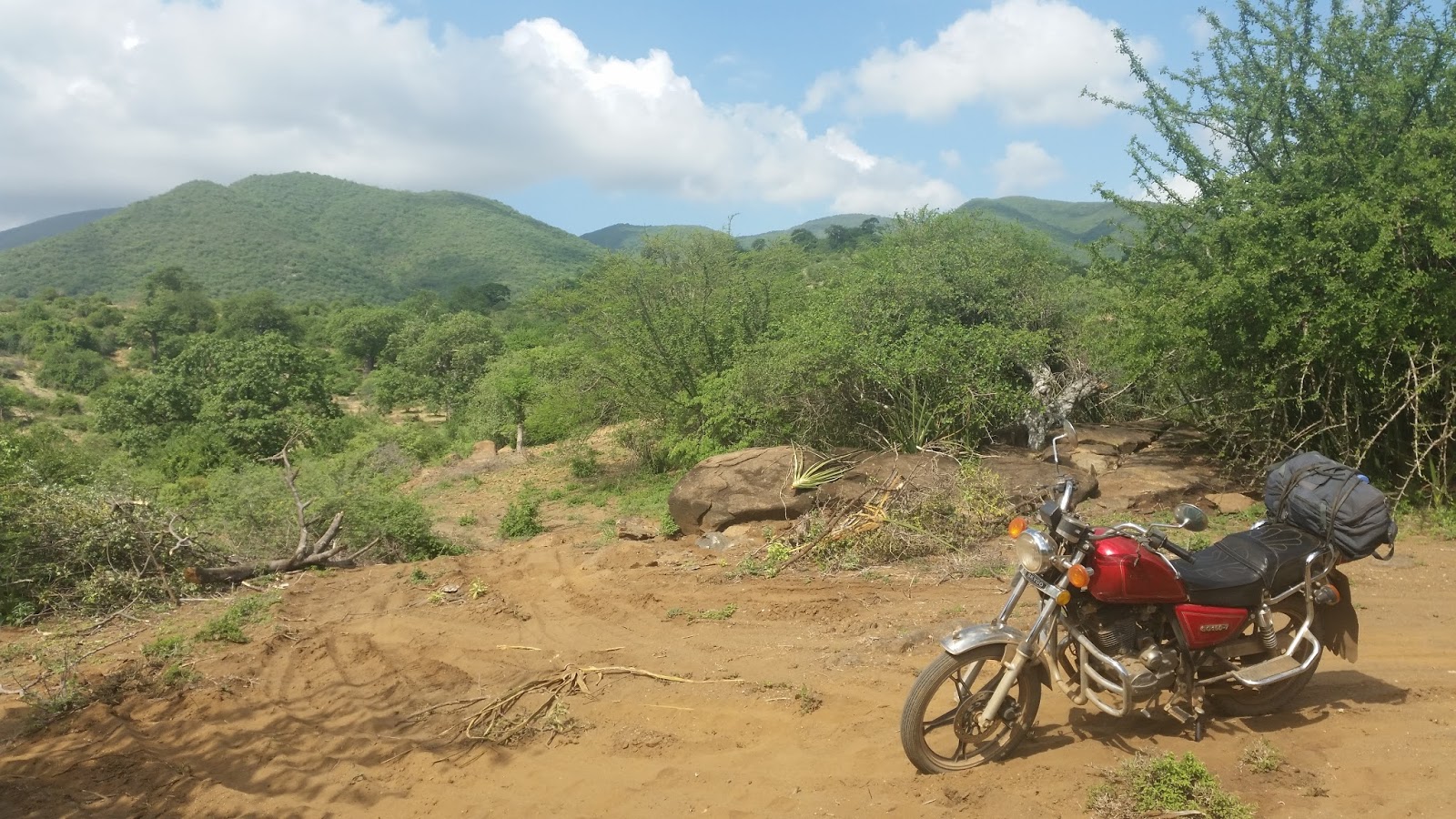
We finally got around to exploring the nearby "Blue Mountains" located south of Moshi. We often pass these mountains on the way to Nyumba ya Mungu but for the majority of the year they are brown and dry with no visible roads or hiking paths. The mountains are also more like hills so there doesn't appear to be any ecological difference in the surrounding habitat; in a sense we always assumed it was just a 'wilder' (less impacted by grazing animals) and steeper version of the surroundings.

Since I had to work Saturday and we didn't have a bigger trip lined up, we decided it'd be a perfect day to get up early and head out towards the mountains. We knew that we'd likely have a better chance of getting deeper in the mountains with a motorcycle but we then lost the shade the car can offer so we best to head out as early as possible. Although I haven't painted quite the most exciting picture, it'd been quite some time since we did a motorcycle exploration and we were both looking forward to a new place.

There are two villages at the base of the mountains and a power line with huge transmission towers run parallel to the mountains. This allowed us to take the "power line road' and choose a few promising roads to cut up into the mountains. The recent area had left the usually dry and dusty area quite green with emerging grasses, baobab trees full of leaves, and a dramatically different feel than during the dry season. We enjoyed the scenery but truthfully most of my attention was on the road, which actually was more like a dried river bed. It was some of the most challenging dry road driving that I've done, with thick sand, assorted boulders and sharp rocks. Worst of all, the thin road was lined with extremely thorny and sharp acacia trees, which meant that if I veered off the road I'd be instantly impaled (okay, a bit dramatic, but I'd have some serious scratches). I'm ashamed to say that we even fell once on a particularly rough climb which hurts my pride more than anything since we a go at such a slow speed that injury is unlikely.

The first road we took was adventurous but led nowhere. It did provide some great views looking down on TPC and then Moshi in the background, and I'm sure if it was clear Mt. Kilimanjaro would have been stunning. We headed back down and tried another road that seemed to be a bit more like a formal road, albeit it had no tracks from other vehicles. This foreshadowed the road turning into a proper dried river bed and it soon became unpassable due to the incline and treefalls. We decided to head back home but bookmarked the riverbed for a possible hiking spot to the top.  

Although we didn't necessarily reach the top of the mountain, we succeeded in having a good time exploring, scouting a possible additional hiking trip, AND getting back to Moshi for lunch. Beating the heat is half the battle in this environment and we're usually too excited looking for birds or exploring a new trail that it's hard for us to turn back when it's early. However, on a Sunday it's good to turn back early to ensure we are not exhausted for Monday at work!

Ana taking in the view

View ont he way up. 

Sunday, March 5, 2017

Shambala Swamp

Swamp with dead trees
This past January I had to travel to a distant government headquarters about four hours southwest of where I live. It was a very uneventful trip (hence I didn't even blog about it here) but I did see something that caught my eye on the return trip; a big swamp. On my return trip I gave someone a ride and they had commented that the swamp was dry for the first time that they could remember. At the time we were experiencing very dry times and the absence of typical "short rains" in December. I decided that when the rains returned, it might be a cool place to check out.

Well, the rains returned last week and when thinking of what to do this weekend, the swamp came straight to mind. Satellite images like Google Earth have their value but in rural areas here it's impossible to tell what roads are for animals, motorcycles, or cars. Thus, at a point we just have to rely on what information we can see from the road and asking local advice. Since I had seen the swamp from the road, I thought we could probably just find our way to the edge of it, despite any clearly marked roads on satellite images.

We left around 8am and it took us around 2 1/2 hours to reach a point where we could see the swamp. The road we had thought to take toward the swamp ended up being a dried river bed, not a road. We hadn't noticed any clear looking roads on the way and instead of backtracking I thought, what the heck, lets follow the river bed as far as we can get. It was true off-roading and I kept a steady eye on the clouds since a heavy rain and flash flood would certainly be unwelcome. We finally made it to a more defined road (relative to!) right on the edge of the swamp and celebrated.

We spent the rest of the day going down the swamp and checking at various points to hike out to see the swamp edge or chase birds in the surrounding acacia scrub. The rains had brought on the green foliage and the area had a higher density of larger trees than compared to the acacia habitats we usually frequent. There were very few people that mostly came from very small villages closer to the main road. They shared that the swamp was indeed dry this year and the water only recently has arrived. They said it wasn't worth it to fish yet but they could fetch water and their cattle enjoyed grazing the marsh.

One very strange feature of the northern end of the swamp was the presence of many dead trees. There was a kind of 10m buffer that contained dried and eery looking dead trees. We asked the locals and they said the trees, "like water, but not too much water. And those trees have too much water", which touche, is a reasonable explanation.

We decided the swamp was likely a great place to do some bush camping, especially after the rains subside a bit. We're not sure how the rains drain into the swamp from above and for sure we don't want to find ourselves getting swept in the swamp in our tent! We'll continue to take trips to explore all the sides that we can and we're pretty happy to have found a new spot to explore.


Totally creepy area, but I loved the vibe. 

View of Mt. Meru. 

View south. 

Mt. Meru in the background. 


Monday, February 13, 2017

Tarangire National Park: Trip IV

Everyone loves a super cute baby elephant.
Two of my co-workers have been here in Tanzania for six months and they haven't gone to a national park yet. I thought back to when we first arrived and how inaccessible and difficult it appeared to go on a self-guided safari. The alternative to that was a hired safari which carried a hefty cost in both time and money that most people working in the non-profit world can't readily afford. This weekend we arranged for a one day trip to Tarangire National Park (Trip I, Trip III).

To force Tarangire into a normal weekend takes some effort but it's totally doable. You can leave Moshi at 5pm and make it to Makuyuni, a tiny junction way-point with one of the best "local" guesthouses we've stayed it, by 8:30pm. Although the drive seems long and navigating through Arusha traffic can be a challenge, I still think it allows you to get a good nights rest. From there it's only a 15 minute drive to the park gate and if you get in early enough the registration process goes quickly.

Everything was very smooth for us as we arrived at Tarangire at 8:30am. It seemed pretty crowded with a few large buses full of Tanzanians mixed in with the typical safari cars and tourists. We registered quickly and hit the river circuit.

Going with first-timers was really a great experience from the beginning. One tends to forget their first moments; when your eyes scan wildly for any type of movement in anticipation of..well, anything. Any log starts to take the appearance of a sleeping lion, or long branch an elephant's trunk. The sight of a warthog half obscured by grass 50 ft away gets you scrambling for your camera and giddy with excitement.

We spotted some relatively common ungulates in the first hour in the park with some great views of waterbuck, gazelles, and zebra. But the real excitement began when we explored a river. We were lucky enough to find two large groups of elephants with some giraffes and zebra nearby. There weren't any other safari cars nearby and it was the quintessential setting with great views over the plains and intimate views of the animals.

The rest of the day was likewise full of good wildlife spottings, though we only saw a solitary lion lazily relaxing under a tree. No cheetahs or leopards but the other wildlife was numerous and densely located along the routes we drove. One of the real highlights was seeing a  dead elephant corpse and hundreds of vultures coming in for the feed. The numbers of vultures in Africa has been decreasing rapidly so it's always a treat to see a large group.

We exited the park around 430pm and made it back to Moshi by 8pm. It was a very successful trip but doing it one day can be tiring! Totally worth it though.

Ana checking out some birds with a big elephant in the background. 

Riverbed. 

Iconic baobab tree. 

Ungulates. 


Monday, December 19, 2016

Tarangire National Park: Trip III

Ol Donyo Sambaa in back of the elephants grazing the swamp. 
This past weekend we took our first "self-guided" safari to Tarangire National Park (Trip I). We had visited there twice before, both occasions when our respective families visited and did a long safari. However, the normal safari route only schedules a half day in Tarangire so we were curious to see what else the park had to offer.

We left on Friday evening and drove straight to Makuyuni, a dilapidated junction town that sits on the main highway from Arusha. I say we drove straight but we actually spent over an hour in traffic in Arusha. They are widening the highway there and we also ran into some esteemed government representatives (rumor had it the prime minister was there). When big wigs from the government come through cities, the traffic police close off the roads for about a half hour. Because of the construction and lack of direction (as well as lack of compliance following rules), we somehow ended up in the middle of six lanes of standstill traffic. We thought we were in serious trouble when a mini bus next to us started to offload passengers and goods but eventually we made it through.

Without traffic the drive to Makuyuni was only about 2 1/2 hours, with another half hour to the park. We were able to find a very decent local guesthouse for $15.

The next morning we headed out early and started to explore the park. Because most tourists come in the afternoon, we basically had the park to ourselves the entire morning. We enjoyed driving along the river taking numerous "river circuits" that looped around back to the main road. The morning was overcast, which was nice, and we saw huge herds of elephants, wildebeests, buffalo and zebra. The short rains must have passed not long ago because the entire landscape was green.

Around noon we reached a drier part of the park as we continued to head south. I wanted to reach a place called Silale Swamp but the map we had was not too good and gauging how long it would take to drive is not easy on poor roads. Compounding confusion was the fact that the park is signed, but a bit inconsistently and lacking details such as how many kilometers remained. As we hit the dry patch the wildlife decreased and the sun broke through, changing the cool breezy drive with several stops for wildlife to a hot and speedy cruise as I tried to get us to the swamp.

We got to a junction that had a sign towards "Silale Swamp Picnic Area" and one towards "Silale Swamp". We turned towards Silale Swamp and immediately the road began to narrow from disuse. There was suddenly a bit of animal life but the elephants we encountered were hostile, likely a result of their VERY small babies and also their negative experiences with poachers and those driving them away when they raid crops. We've seen skittish elephants before and it always gives us an appreciation for the tame ones that we do see. A scared elephant is no fun to see, especially when it's you as a human that is scaring them.

We finally decided we'd gone far enough and turned around. Our spirits were a little low and it was past lunchtime but I told Ana that we'd try to go to the Silale Swamp Viewpoint and if we didn't reach in 20 minutes we'd just eat lunch at the side of the road. Luckily, we reached Silale Swamp (+ the picnic area) in about 10 minutes and were greeted with an unbelievably picturesque view. We set up under a tree and watched the wildlife for about an hour before packing up and heading back.

On our way back we met a big rainstorm that was a welcome relief to the dry conditions we met in the south of the park. We encountered a big herd of elephants crossing the road and I let them pass about 10-15 meters ahead of us. They had some tiny tiny elephants with them and the last elephant, a big bull, was not too happy with our positioning. He kind of turned and jogged backwards facing us, and then trumpeted a warning shot. My heart just about dropped out of my pants as I instinctively shifted the car into reverse and floored it.  Just a warning, nothing serious, but I learned something about elephants and space!

A lone male in the morning digging for some minerals. 


Very green landscape. 

Approaching the swamp. You can see how dry it is before the swamp. 

It was a nice view

Ana checking out some birds. 

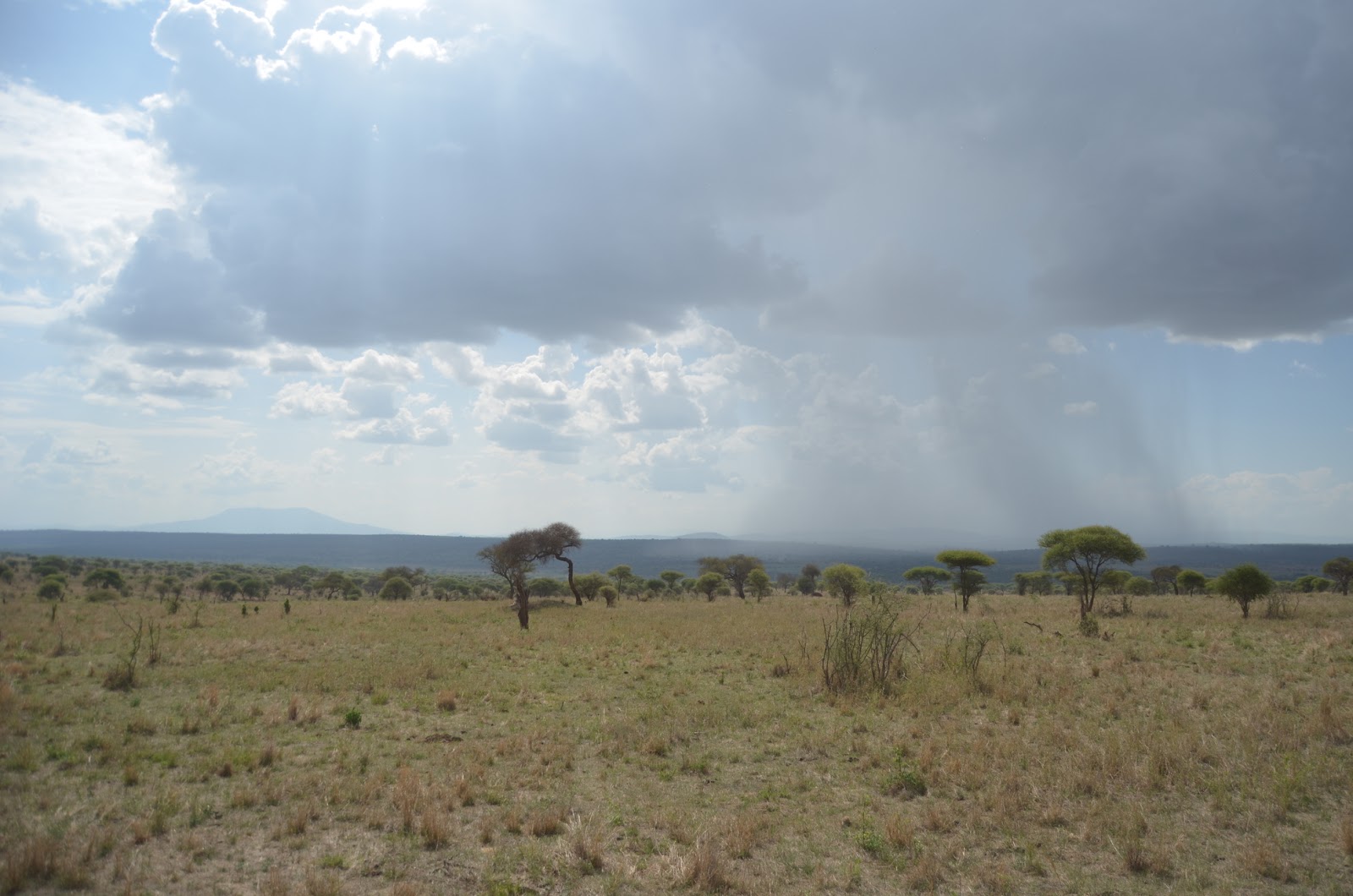
I love seeing sheets of rain across the plains. 
Passed a bunch of giraffes on the way out. Check out the one hiding behind the trees. 

Elephants in the rain. 

Saturday, September 13, 2014

Tarangire National Park

Map of the national parks in northern Tanzania and Kenya. 
Comprising 2,600 square kilometers (1,000 square miles), Tarangire National Park is a stunning wildlife area in the heart of the Great Rift Valley. It lies adjacent to the Tarangire Conservation area and next to Lake Manyara National Park. It's a common stop on the "northern safari circuit" of Tanzania, though often skipped over for Serengeti National Park and Ngorogoro Conservation Area.  However, wildlife is abundant and as a result of the permanent waters of Tarangire River, animals flock to the park from July to October (dry season).


Getting ready to board the vehicle. The cars have awesome pop up roofs that give a great vantage point. 
We entered the park around 11AM which surprised me as the majority of wildlife tends to be more active around dusk and dawn. However, with these types of things, you've got to learn to trust in your guide. And in the end, there was absolutely no reason for my concerns.

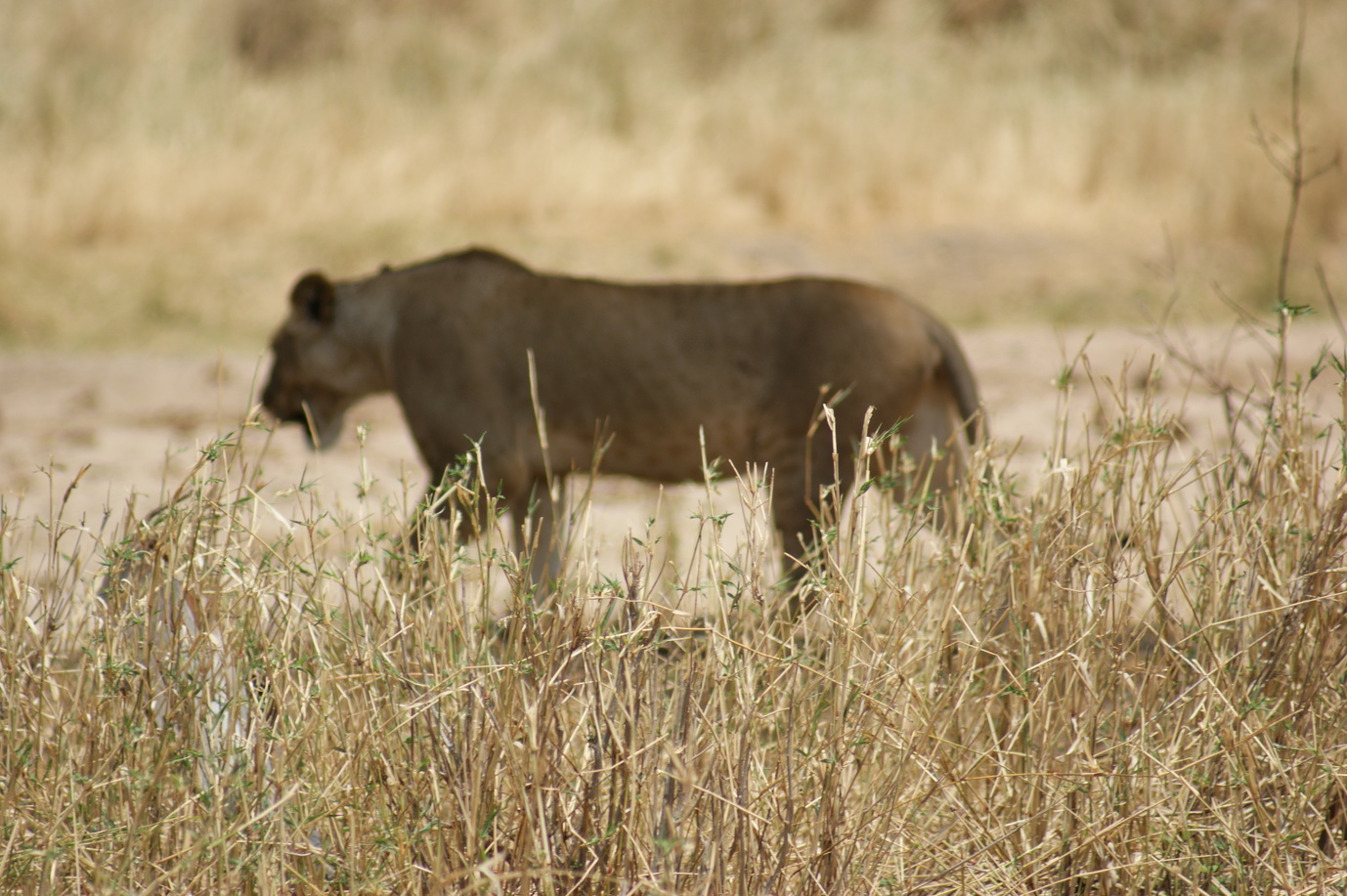
The park is a classic savanna though containing a fair concentration of trees, especially the iconic baobab trees. There are a variety of habitats from grassland and woods to low hills, scrub and swampland. Cutting through all these habitats is the Tarangire river. The river beds had abundant wildlife with hoards of elephants and giraffe. I was shocked at how habituated the elephants were as our car drove right up next to them, literally able to touch them (though ill advised). We saw a lone lioness relaxing under a tree and other guides told us she just had a failed hunt with another lioness. She awoke to find another bush to lay under as elephants drank water in the background.

We continued to drive through the park with spectacular wildlife. Elephants, giraffes, zebras, ostriches, warthogs, gazelles, and dik diks were abundant. Having been on safaris in a few other national parks in other African countries, I was shocked at how plentiful and habituated the animals were. Animals only seemed bothered when crossing paths with vehicles crossing the road and the skittish and elusive behavior of animals in other parks was absent. We quickly learned that clusters of other cars was a good sign and it meant there was a something good. The highlight of the day came when someone had spotted a cheetah laying under a bush. Although it was far and inactive, it was still a treat to see. 

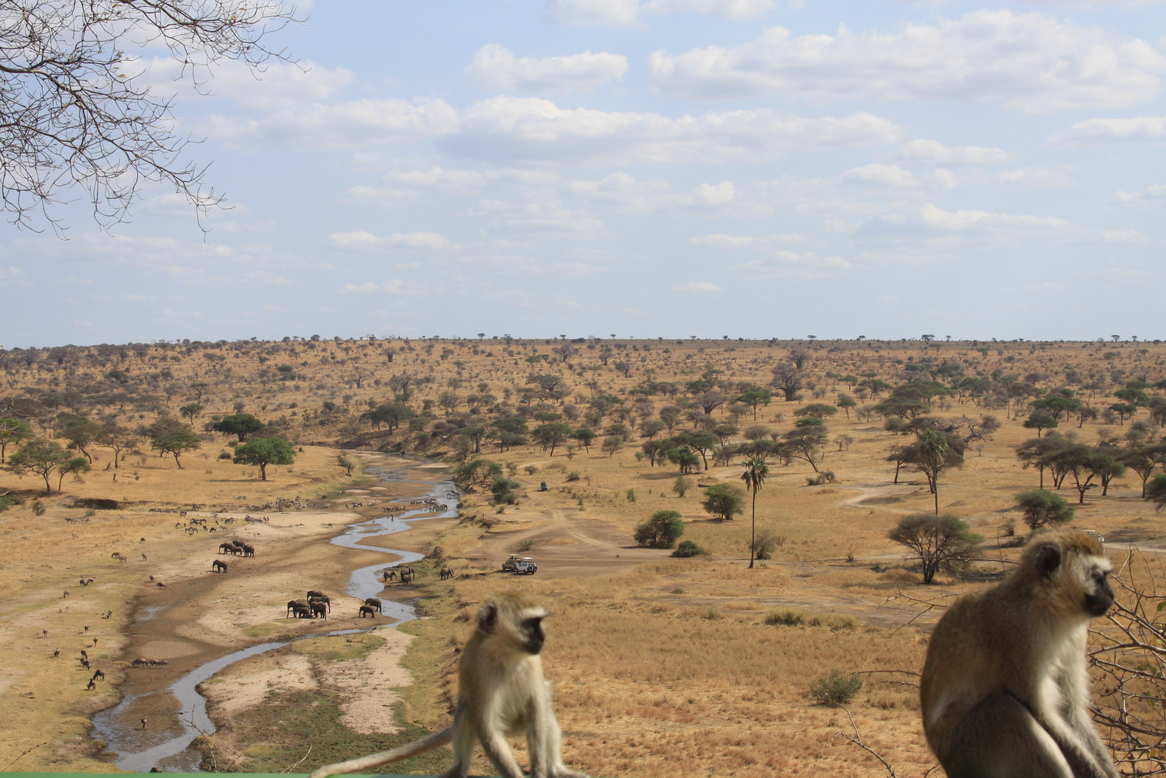
We had lunch at a beautiful vista of the river. Lions and zebras dotted the river taking water, along with various ungulates. Vervet monkeys, baboons, and starlings all terrorized the picnic area. One of the people in our party was victim of a monkey theft as we sat eating. The bold monkey literally came up from behind him and took his biscuits off the table as we sat eating!

We basically drove around until the sunset. Our guide had a radio which was used to communicate with other guides about animal activity. When we passed other cars the drivers would stop and trade information. The park certainly had many visitors but nowhere did the place seem overcrowded and there were many moments without another car in view. 
A baobab tree that has been damaged from elephants looking to extract water from it. 
Lioness through the grass. 

Lioness with elephants in the background. 

A cheetah takes a nap under a tree. 

Vervet monkey plays in the trees. 

Lilac-breasted roller. 

Giraffe takes a bite. 

Elephant family on the move. 

A different elephant family, seemingly inspecting the vehicle full of mammals in front of them.

Landscape to the east with the Tarangire river. 

Picnic spot. 

Crossing rivers on safari always feels legit. 

Dead elephant carcass, supposedly from natural causes.