Showing posts with label Mara Region Travel. Show all posts

Saturday, June 27, 2020

Serengeti lodging: Kubu Kubu Tented Camp

The pool was VERY cold!
We were lucky enough to score an incredible deal at Kubu Kubu Tented camp. I hadn't realized it at the time, but we've actually stayed at two other properties owned by the same operator (Maramboi and Kati Kati) and had been impressed by both. We were excited to stay at this tented camp which was a kind of hybrid between a built up hotel and a fly camp. I suppose the name "tented camp" is appropriate.

The location of the camp is excellent in northwest central Serengeti. Seronera and even the western corridor are all easily accessible. The views over the plains are beautiful and there is no other camp in sight. We heard lions and hyenas in the plains below us every night and we even saw a hyena poking around the main lodge early one morning.

There are 25 tents available and I imagine if the place was full it might feel a little cramped but with few guests during our stay it was perfect. The tents are tastefully furnished with all the amenities one could ask for. I appreciated that they had a large drinking water dispenser and the outdoor shower was crafted quiet nicely. They were a little too close together and you could hear your neighbors early morning conversations and wake up calls. The staff was excellent and food delicious.

I always try to view the lodges through the lens of a first time visitor and in that regard the place did not disappoint. They even had a gym that was open air and facing towards a beautiful vista. Working out can be quite nice after sitting in a car all day, especially for a multi-night safari. However, since all the accommodation in Serengeti National Park are quite expensive, even the cheapest place is likely to have impressive amenities and services.

Overall I'd absolutely recommend Kubu Kubu Tented Camp!
Comfortable bed.

View from our balcony.

Inside leading to a very nice outdoor shower.


Serengeti: Trip III

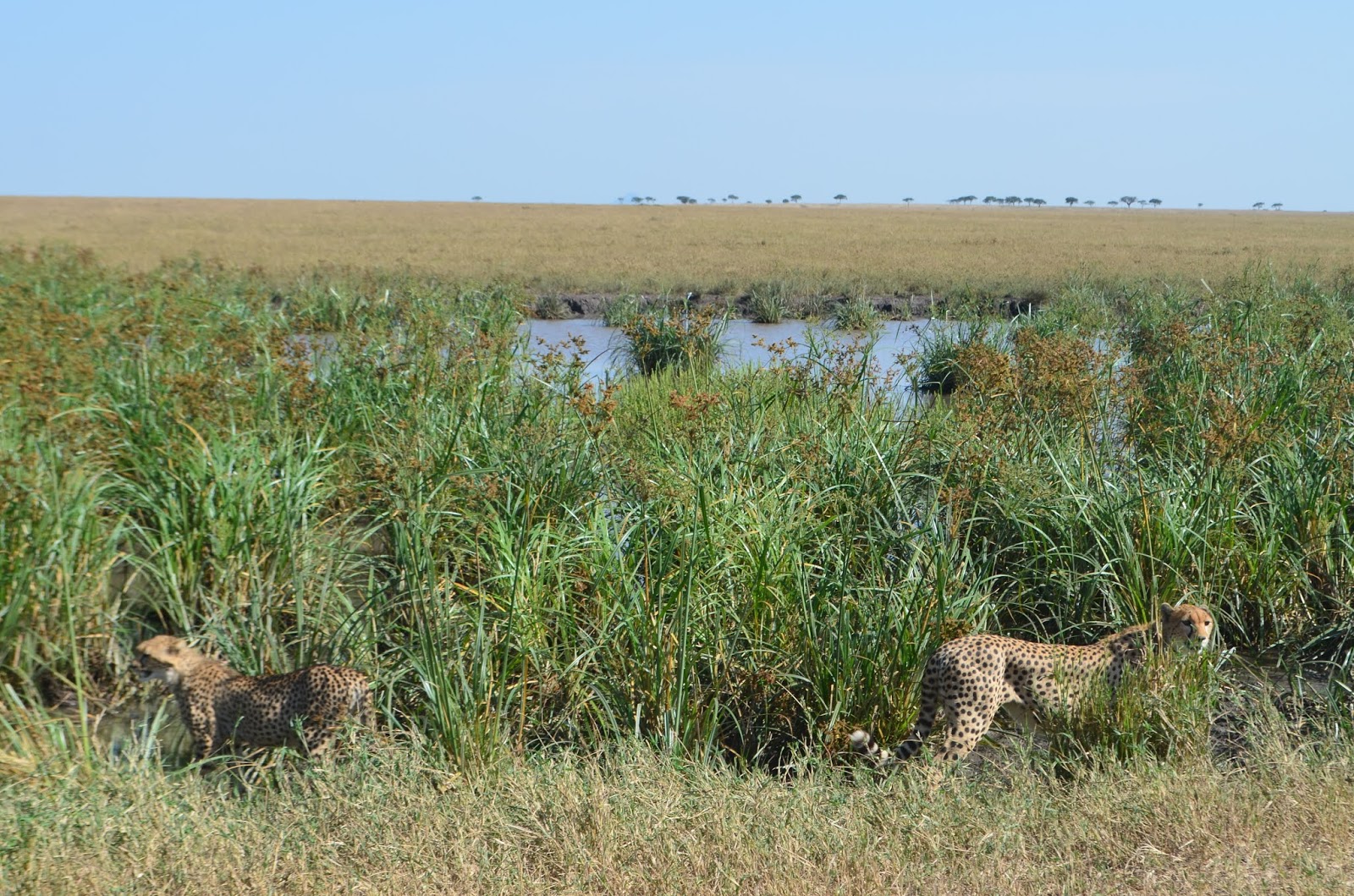
Best sighting of the trip
With tourism down to unprecedented levels, the opportunity to experience Serengeti without the usual crowds was something we could not pass up. Our previous trips (Trip I, Trip II) were both phenomenal and I hold the Serengeti National Park on a pedestal far above any other national park I've visited in Africa. The density of wildlife is unparalleled. The only drawback, which is becoming a more frequent complaint, is that the park is overcrowded. Many people are surprised when they come on safari and see 10 other safari vehicles around a pride of lions. It can be a little annoying to have to overhear the conversations of the occupants in the other vehicles or jockey for position to get a good viewing. This can reduce the intimacy of the experience but it also helps to have so many eyes out browsing the landscape; information about sightings are communicated quickly through guides so locating rare animals become easier.

Ana and I had discussed the possibility of trying to visit the Serengeti without tourists and when my friend mentioned an amazing offer that one of the lodges was having, we literally booked our trip within 24 hours of receiving the information. It seemed like a truly once in a lifetime experience.

And sure enough, the trip lived up to every expectation and was a special experience. We arrived at the gate and it was stunning to see it empty. Typically you see up to 50 safari vehicles waiting in line. As we finished checking in we saw a touristy-yet-resident looking guy was checking out and I thought to myself, "hm, maybe there will be more people here than I expected...". We saw a caravan of five vehicles exiting the park shortly after we entered and I tried to taper my expectations regarding the relative emptiness of the park. Little did i know, those vehicles I saw within the first 10 minutes of arriving would be more than I'd see throughout our three nights in the park!

We only saw two other vehicles with tourists and none were at sightings of wildlife. Every single pride of lions that we saw (4 or 5 groups) we had to ourselves, including ones with kills. We were lucky enough to see the wildebeest migration in full force with no one else in sight. Three cheetahs on the road going to a wetlands to drink? Only us to watch them. It was kind of like low season in Ruaha only with 5x the density of wildlife.

Having the park to yourself doesn't just add intimacy to sightings but it also creates a kind of feeling of adventure. We had a map and relied on the ecology of the area (grasslands, rivers, etc) to identify our daily plans. We had some great drives and some long uneventful grass filled drives. Because tourism numbers have been way down since the rainy season many of the roads in the grasslands were very difficult to follow and all the smaller roads felt like no one had passed in weeks.

We were on the fence about this trip for a while and in the end I can't believe we even hesitated. The Serengeti will likely never have as few people and even when we came out on Saturday morning we began to see many more cars coming in, likely weekend trips from Arusha. Working in the field of conservation has certainly spoiled me rotten and this trip might have just put it over the top.

Saturday, January 30, 2016

Serengeti National Park Trip II

Lions in a tree.

My second time to Serengeti National Park (Trip I) was completely different than my first trip due to the fact that this trip was after a bit of rain, while my previous trip was during the end of the dry season. We were also able to spend a few days there instead of a quick in and out.

As usual, Serengeti National Park and its endless plains were a real treat to spend a few days in. And it is a good thing that I am satisfied with the landscape alone because due to the rain pattern, the park was a bit sparse in wildlife. Around the central area of the park there were some lions and giraffes, though the ungulates (buffalo, zebra, etc) were quite sparse. We did get to visit one of the hippo pools which, true to its name, was loaded with hippos.

Our accommodation was a pretty cool set up at a temporary camp in the middle of the park. It consisted of a main camp with about 10 smaller tents on the periphery. It was pretty cool to hear hyenas and other creatures of the night lurking around at night (though some in our group were less enthused) and you could even hear them scratching against the tents! The major drawback of the place was that you couldn't walk anywhere outside the camp. Unlike many people think, the real risk is buffalo as there is a very low likelihood that you'll be eaten by a lion or leopard. I love to get out and walk, so being contained in a very small area was a bit frustrating, though this is my biggest "complaint" with traditional safaris.

I still would one day love to go through the north of the Serengeti but as I'm learning, it all depends on the time of the year as the landscape and wildlife are constantly changing with the rains.
Our campsite where we spent two nights.

The plains of the great Serengeti!

Hippo pool, with more hippos than I've ever seen in my life.

Plains with characteristic rock formations. Lion King style.

Lonely croc with his mouth open, waiting for an unsuspecting young animal to crawl in.

You want grass? Serengeti has grass.

Saturday, September 27, 2014

Maasai village visit

Maasai performance
One of the most common "add ons" to a safari is a visit to a Maasai village. The Maasai are one of the most well known ethnic groups in Africa, known for their colorful clothe, "jumping" rituals, long skinny physique, and resistance to Westernization. The Maasai people are traditionally semi-nomadic and are most prevalent in southern Kenya and northern Tanzania. They are pastoralists and have resisted and fought with the governments of Tanzanian and Kenya to maintain traditional grazing rights in national parks and other protected areas. I have reviewed a great book regarding the history of wildlife management and conflict with Maasai people, In the Dust of Kilimanjaro by David Western.

Although the Maasai have long rejected modernization, they are now quick to capitalize on the high levels of tourism, a seemingly strange contradiction between their fight for their pastoral and self sufficient lifestyle. One can't help but admire a culture for resisting the urge to be modernized with permanent houses, schools, the English language, and other culture brought from colonization, especially in light of what appears to be a unique culture. Still, as with most indigenous cultures around the world, there is a tendency to romanticize the culture, especially while viewing it through the lens of a short village visit between game drives.

My first interaction with a Maasai was through our bird club. As most of the members of our bird club are aspiring tourist guides, Lukas, our friend, was no different. He had grown up in the traditional Maasai lifestyle, migrated to a nearby village for work and was employed by an NGO as a security guard. For some reason, the Maasai's most common line of work is as a security guard, so Lukas's story is a common one. There he met a Dutch woman, they fell in love, and she sent him to college where he completed a degree in wildlife guiding. Again, not a totally uncommon line of events for this area. Now, Lukas joined our bird club and we thought he was going to be an awesome birder due to the mystique that surrounds the Maasai and their interactions with wildlife. Unfortunately, he was quite below average and even seemed to be a bit bored of birding when we were out.

Over the course of our trips I began to ask Lukas about Maasai life. I thought I was tactful in my inquiries about his culture and he was very open to sharing his experience. He told me that the earliest he went out to tend his familiy's cows alone was when he was eight years old. He spoke in depth about how much he loved to be alone and how easy it was for him to "cool his mind".

Later that week he called Ana and I and said he wanted to meet. We didn't know why but we agreed and met him at a local restaurant. In our previous interactions he was wearing western clothes but this time he was in full Maasai garb. He presented us with a brochure highlighting a local Maasai village and the way he presented himself to us really turned me off. I had thought we were friends and at least I had thought I had explained my desire to stay away from "non-authentic" villages so the fact that he dressed up and brought us a generic brochure was disappointing. Still, he presented us with his "thesis" that he made for school which was about Maasai culture and animals. They were somewhat crude handwritten books but we borrowed them to learn more. Either way, it was a revealing interaction.

My second interaction with Maasai is through a non-profit that Ana and I provide with pro-bono consulting. The organization works to end the practice of female genital mutilation (FGM) among the Maasai, a mandatory coming of age practice for women. We assist them in writing proposals to gain funding and it is obviously a darker side of the culture than we are presented with in the village-tour brochures. I'll save the FGM for another post but needless to say, it gave us a new perspective on their culture, especially as it pertains to just how paternalistic their society is and how few rights women have.

So on our safari we knew the guide would suggest visiting a Maasai village. Ana and I were not thrilled at the prospect but her parents wanted to go. We paid $20 a person to view a village. We were told that we should take as many pictures as we want. I found this interesting since the Maasai had previously fought this practice claiming that it "takes their blood" yet apparently either they changed their beliefs or were content being compensated for it. There was one English speaking guide and he introduced us to the village and a group of men did a "welcome dance" with much less than $20 of enthusiasm. They even paused mid-dance when they thought another safari vehicle was coming but alas, it was just turning around.

We were then herded inside of their "village" and crafts lined the walls of the interior. We were told that the women made the crafts and the proceeds would go towards the women's group. The guide said to pick what we liked and we'd negotiate a price in the end. I was somewhat skeptical of the existence of a women's group knowing the culture of the Maasai though it's not unheard of in some villages that have worked with NGOs and other development organizations.
Outside of the village area. 

The tourists look on, obviously one is not very pleased. 
The tour was already pretty uncomfortable for me but the last part of the tour really made me furious. We were given a tour of the "school", a place where children had gathered and gave a cute though contrived and forced welcome to us. The "school" was a small hut with a donation box in the middle and a chalkboard with permanent writing with the ABCs. The students sang us a song and the guide told us they come here to learn. I was furious at this because it was clear the children did not receive regular schooling and I can't imagine how many people came before us and stuffed the donation box, yet the "school" remained a hut which I can only imagine was unoccupied when tourists weren't there.

In the end Ana's family enjoyed the tour as it was a peak inside the culture of a group they had recently become familiar with. For us, it was a disappointing shallow interaction with a group that had successfully commodified themselves. I think cultural tours are an excellent way for local people to benefit from tourism but I was furious and disappointed that they manipulated tourists emotions regarding the women and the school to extract more money from tourists. I think a fair and accurate presentation of culture should be presented, or perhaps I think those who view these cultures in a brief moment of time should take the responsibility to learning more after they leave. However, I do understand that most people are on vacation and simply want a picture with a group of cute kids jumping in the air.
The "school". 

Performance. 

Saturday, September 13, 2014

Serengeti National Park


Serengeti National Park is likely the most famous national park in the entire world and for good reason. I was worried that my expectations were too high, especially given my recent binge on BBC and National Geographic nature documentaries. However, my two days in Serengeti were as unforgettable as any in my life and the landscapes and animals were unique an.
A view to the south at the park gate. 
A look into the iconic and dry Serengeti plains. 
Serengeti is Tanzania's largest national park at 14,763 square kilometers (5,700 square miles or half the size of West Virginia). It lays adjacent to Ngorogoro Conservation Area to the south, Lake Victoria to the west, and Maasai Mara Game Reserve in the north. It's best known for the insane numbers of wildabeest and zebra that migrate during the change of seasons and also for the iconic plains in the south of the park. The name comes from the Masaai word “siringet” which means “endless plain”. However, the main attraction is the wildlife, more specifically, predators. Lions, hyenas, cheetahs, leopards, and birds of prey can all be spotted with one of the highest densities of predators of any park in Africa. 

The drive in from the south was startling for it's barren nature. The landscape was flat for as far as you could see with brown grasses covering the seemingly desolate landscape. Hard to imagine that when the rains come the landscape would be transformed to green with millions of grazing animals. For now, only a few solitary ostriches roamed about. 

The rains started about two weeks ago so the landscape became a bit greener with huge packs of zebras and gazelles grazing. We saw a few different prides of lions that were lazing about. It was pretty cool because the zebras would form a large semi-circle around the lions while grazing, always on alert. The highlight came in this area when we saw a cheetah stalking a gazelle. The cheetah crouched in a low position and moved slowly, stalking the gazelle with an intensity that I could feel. The gazelle caught on and for a moment both animals were frozen. Suddenly the cheetah flinched and and the gazelle shot off like a rocket. Unreal!

We made our way to the center of the park which was a bit more hilly and had some rivers and marshy areas. The wildlife sightings continued to be numerous with several lions, giraffes, gazelles, wildebeests, hippos, zebras, and ostriches. Less commonly seen were hyenas, jackals, and elephants. We drove through the park all day and in the central area the changing landscapes were mesmerizing even when there were no big animals to view.

We spent the night at a luxury lodge in the center of the park and saw hippos, baboons, rock hyrax and warthogs pass through. We then got up early for a game drive at 6AM and then another game drive after breakfast till we exited the park in the afternoon. We took our time as we exited and we passed through the same southern route as when we came in. So much of the park was left unexplored but there is always next time!

A cheetah positions itself for a hunt. 
Zebra!


This lioness had a radio collar, likely part of a research effort. 

A solitary lion basks in the sun. 


An agama lizard. Even the reptiles are more awesome in Serengeti. 

Zebras graze the endless plains. 

A lion seeks refuge under an Acacia tree. 

Iconic landscape. 

Ana and I good to go on the morning Safari. We spent most of our term standing on our seats with our heads popped out the front hatch. 

Cross-roads in the park. 
This lion was not shy. 
This was a rock called "Lion Rock", which was unsurprisingly colonized by lions. There were at least five that we saw with cubs taboot. 

Lion cubs sleeping in the shade. 

View from the hotel. 

You can't imagine how much chlorine was in that pool (I did not swim). Looks nice though!