Wednesday, January 26, 2022

Climbing Mt. Kilimanjaro: 6 day Machame route

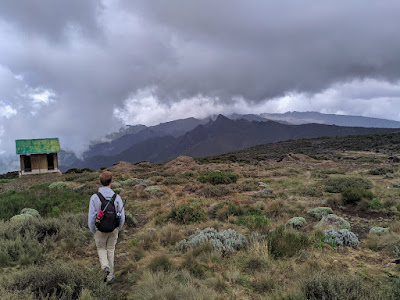
Shira Camp
 

My young brother decided he wanted to come to Tanzania to climb Mt. Kilimanjaro and naturally I decided to join. We were accompanied by one other person making our climbing group a total of three. We climbed the 6 day Machame route and there were relatively few people on the mountain due to the Omicron variant and the post-holiday "shoulder" season. 

You'll find a ton of information regarding climbing Mt. Kilimanjaro scattered throughout the internet so I'll just cover a few personal points here. The most important take away for me was that it is not necessarily your physical fitness level rather it's the pacing of your hike and acclimatization that is the most important. Everyone in our party felt the effects of altitude at some point or another and even though we adjusted, that "adjustment" was still massively uncomfortable. Our pace often seemed exaggerated with how slow we moved but I do think it paid off to not exert ourselves. I had gotten altitude sickness one time before in Colorado at a place that was only 3,431m (11,256ft), which is lower than everywhere after the 2nd day of the Kili climb! But that day in Colorado I was chopping wood and hiking and by the evening I had an awful headache and general nausea. I was slightly concerned about the altitude at Kili but a combination of taking Diamox (altitude sickness med Acetazolamide) and really watching our exertion helped us through. There was a fair amount of mental attrition that was also necessary due to the fact that your body clearly does not want to continue to starve itself of oxygen yet you continue to trudge ever higher.

The first few days of the hike were great and the camp sites and trails were not too overcrowded. I was disappointed at the amount of litter that was on the trail and disturbed by the trend of guides and porters blasting music from their portable bluetooth speakers. I think that the experience would have been vastly different had the mountain been crowded or the weather poor, but in the end we really lucked out with near perfect weather and open trails and camps. 

For all the beautiful hiking that Tanzania has to offer, hiking Mt. Kilimanjaro clearly represents a more metaphorical or self-discipline type of hike. I'd be hard pressed to find anyone that considers the last two days "fun" but I understand why people would have various motivations for reaching the summit. It's certainly not my type of hiking or backpacking but I was happy to join my brother on the adventure.

Total epic campsite at Barranco campsite. 

View from the Barranco Wall.

What a view 5000+m up


Friday, December 31, 2021

The dogs and the tortoise


Who is the boss here?
 

In the rainy season it is common to see Leopard Tortoises strolling around, some are huge (the biggest specimens have been reported to be up to 60 kg/132 lbs) while others are tiny. One recently came through camp and the camp dogs were agitated beyond belief. I imagine that they usually flush anything out with aggressive barking but due to their speed and natural fortification, the tortoises stand their ground or just carry on. I think the dogs are flummoxed by the lack of respect and it makes them nervy. 

They eventually made their way to sniff the tortoise and I felt the need to intervene on behalf of the poor guy. I shooed off the dogs and let the tortoise be on its way.

Thursday, December 2, 2021

Ruaha National Park: End of the dry season


Consumed buffalo

One of my favorite times to visit the park is after the first rains in late November. I feel there is a strong chance for a small rain in October, of which provides immense relief after months of arid heat, and then the first real rain of the year sometime in November. The end of the dry season is an amazing time as the landscape slowly transforms itself filling with insects, grasses and migrating wildlife. It's difficult to articulate just exactly how tough conditions are at the end of six months without any rain but the landscape feels completely parched. Even though wildlife is easier to find congregating closer to permanent water sources, it can almost feel apocalyptic with how dry conditions are. 

With that being said, I was thrilled to find myself in the park a few days after some rain. In the morning it was overcast giving way to picturesque Ruaha conditions and in the afternoon the sky was vivid blue with striking massive white cumulus clouds. 

We saw loads of wildlife with a big herd of buffalo around the Mwagusi and a pride of nearly a dozen lions following close behind. Even without the wildlife it would have been one of my favorite trips of the year. Something about the transforming and relieved landscape is palpable along with the beautiful light and colors of freshly germinated plants...

A totally maneless male.


Monday, November 8, 2021

Dar es Salaam


An average view of Dar es Salaam.

Through a set of circumstances with work, Ana traveling up north for a training, and the need for a change of scenery, I spent a week in Dar es Salaam this past month.

I have never been a fan of Dar es Salaam and when we used to live in Moshi we rarely visited. These days the nearest international airport is Dar es Salaam so we usually pass through, and our work expanded to an area that also results in us spending more time in Dar es Salaam in transit. As the true economic capital of Tanzania I always having a running list of things to do while there (get an eye exam, purchase laptops for work, follow up at a government office for a permission letter...) and there are also some nice restaurants, certainly more options than Iringa!

One of the features I least like about Dar es Salaam is the coastal climate. The majority of the year it is hot and humid. Many of the businesses in Dar es Salaam are still without climate control capabilities and thus I am typically sweating prodigiously. While Dar es Salaam is by far the biggest city in Tanzania, it is quite disappointing for big city standards internationally, certainly a minnow compared to the more cosmopolitan Nairobi. It has the feel of a local traders hustle bustle city rather than an international business feel.

One of my favorite unique features of Dar es Salaam are the fruit bats that come to roost every evening. Many of the compounds and properties in Dar still have massive trees and thousands of these bats come out at night, check out the video below:


Saturday, October 30, 2021

Ruaha National Park: Lunda


Near desert like conditions.

The Great Ruaha River runs from the headwaters in the Usangu wetlands up towards the Mtera Reservoir. As the river runs north the landscape becomes lower and drier resulting in an arid near desert with spectacular riverine forest along the Ruaha. The river eventually splits into two and then fans out into a massive wetlands before spilling into the Mtera Resevoir. The northernmost part of the ecosystem is dominated by black cotton soil and whistling thorn acacias. It can be a hostile environment and wildlife densities are lower than other parts of the Ruaha River. Still, there are good populations of eland, zebra, giraffe, and waterbuck, as well as healthy populations of lion and elephant. 

Lunda is seldom visited due to the distance from the heart of Ruaha National Park where the Mwagusi and Ruaha rivers meet. I don't fault most visitors for not wanting to brave the heat for sparse game viewing but the habitat is uniquely different from the wetter parts of Ruaha National Park. If one has the chance it's certainly worth checking out.

Riverine habitat.

Classic Lunda.


Saturday, September 11, 2021

Dry season hike

Nothing like walking in a dry river bed early in the morning.
 

The dry season can be brutally hot and seemingly devoid of life. Wildlife congregate at dwindling water sources and landscapes look dry and unwelcoming. If you want to go on a hike in peak dry season, best to go as early as possible!

As tough as the dry season can be, there is a beauty to the dry aesthetic and any active critter or plant that draws your attention probably has some interesting adaptation to check out. One of the other advantages is that you can access all types of areas. I am particularly fond of either walking along the ridge of a river bed or inside the dry river. It's an amazing experience to look for tracks and signs, though in our area you have to be careful to not sneak up on any elephants or buffalo!

Elephant damage.
That is some tall grass.

Monday, July 19, 2021

The Rufiji River

Sunset on the river.
 

While we have done more adventurous exploration of the Rufiji River (Trip I), our latest trip was not as intensive though still interesting. We are still getting to know the area so it's exciting to check out new areas. The main highway, going north/south from Dar es Salaam all the way to Mozambique, bisects the large mouth of the Rufiji River. One of the longest bridges in Africa, the Mkapa bridge (named by and for the third president of Tanzania, Benjamin Mkapa) is a notable feature in the area. 

There are settlements on both sides of the Rufiji River as you head west. On the north side of the river there are over a dozen villages before you reach the gate of Nyerere National Park. On the southside of the river there are fewer villages heading to the local administrative capital called Utete, the last village before the entrance to the Kingupira side of Selous Game Reserve.

I've gone down both ends but these days I spend more time on the north side. It's amazing how wild the river remains even with heavy traffic from small boats. Crocodiles and hippos can be seen and heard all along the river. There are a few larger permanent lakes, ponds, and shallow pools, some of which will dry up during the peak of the dry season.

The amazing plant, Desert Rose