Saturday, January 18, 2014

The Bizarre House of the "Chess Master"

I was casually chatting with a coworker and he was asking me about what I like to do in my free time. I mentioned chess and he perked up, immediately getting excited and telling me he knows a "chess master". He was so excited that he asked when I was available to meet him; if it was tomorrow, he'd come by and pick me up to take me to his house. He explained that this guy was "his mentor" and he was quite old, had a French club, and enjoyed chess. These details are enough to intrigue to arrange for a meeting.

I told him I was available the next day and sure enough, he picked me up. We went to this guy's house, which was a typical set of rooms in a larger compound. I was immediately shocked by the amount of chess boards and chess paraphernalia that was scattered throughout his house. It was somewhat organized though the sheer volume of chess boards made the place feel a bit claustrophobic and certainly bizarre. I'll let the pictures do the talking to save you a thousand words.

This is the first room when you enter the house. There are a few chess boards you can't see pictured to my left and right. 
There were two rooms (to the right) and the hallway was full of chess boards and chess paraphernalia. 

Room number one had stacks of books on all sides, along with random chess boards and chess pieces. 
Room number two had chess board boxes stacked in all corners of the room, as well as chess boards in seemingly every crevice.  

Ana looks on as I play my coworker in chess. 
The strangest thing about the whole event was that the "chess master" was actually not very good at chess. I'll admit that I lost the first game but I blame the distraction of being in a bizarre chess-fun house. I'm not an expert chess player by any means but I know that if I play anyone that is very skilled, they usually beat me in 10-15 moves. Ana and I played quite a bit in Spain and Uganda, but ever since she started studying and regularly beating me, I've become a bit of a sour opponent to play against. Thus, we were both happy to find a forum to play chess, albeit a surreal and strange venue. Hopefully next time I can be a bit more focused. 

Tuesday, January 14, 2014

Hot springs at Boma Ngombe

I had heard about some hot springs between Moshi and Arusha and was keen to check them out. First we took a dala dala to Boma, which was 1000 TZS ($0.93) and about a 45 minute ride. We then negotiated with the vibajaji drivers to drive us another half hour to the maji moto, or hot springs. The scene of vibajaji drivers reminded me of an auction as about ten of them were ready to take us. They initially showed solidarity by demanding 30,000 TZS ($18.55), though one of the younger guys quickly budged when we demanded 20,000 TZS ($12.37). 
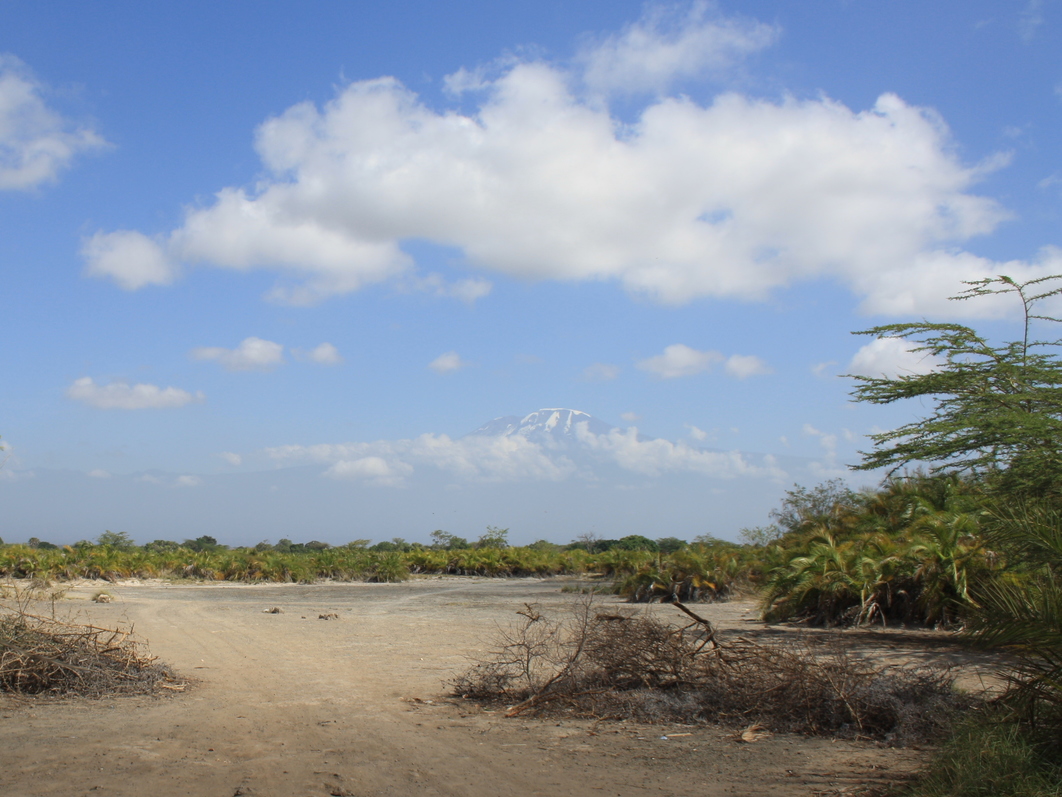
The vibajaji (locally known as banjaji) got stuck in the mud so we had to get out and push. Kili looks on in the background. 

The ride to the springs was through a very dry landscaped, dotted with small villages and settlements. The dirt road twisted and turned and I realized I would never remember the correct route on my own. At one point we came to a flooded area. Our driver thought he could make it and we ended up stuck in the mud. The vibajaji's are conveniently tiny, so we had no problem getting it out and through the mud. 

View of Kili from the springs. 
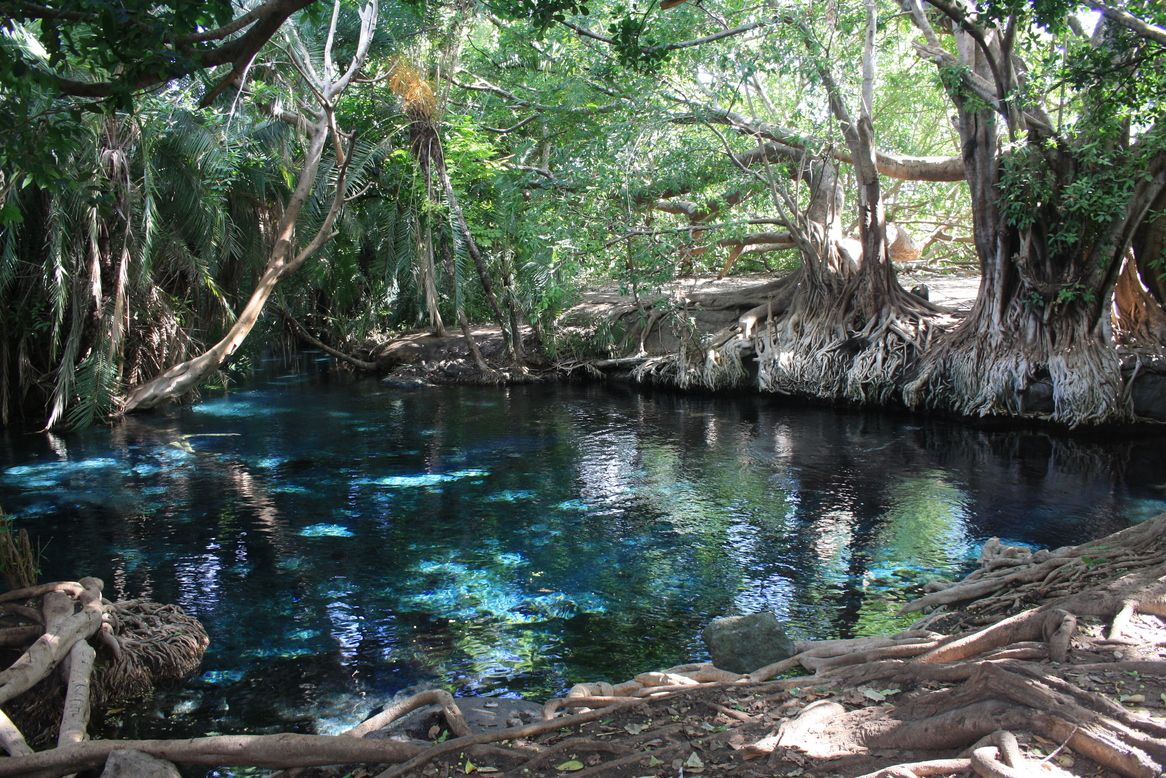
The springs appear like an oasis in the dry landscape. Large trees and lush green shrubs suddenly occupied the space between the barren land. We pulled in under a shade tree, completely alone. There were signs of a semi-permanent area with a few benches and a tarp covering some goods. We had chosen to come early in anticipation of other guests due to the popularity of the springs.

Parked under the shade of gigantic tree. 
The hot springs weren't exactly hot springs as I think of them. They weren't very hot, though they were warm, and they didn't have the smell of sulfur like previous hot springs I have visited. Still, the springs were beautiful and temperate. There was also an abundance of wildlife with striped mongooses grazing the ground and baboons and vervet monkeys in the trees. Our friend was excited with the monkeys and kept following them around taking pictures and watching them. He was curious why Ana and I didn't find them interesting and we basically said we were jaded after working for a primate conservation organization and besides, monkeys are a pain in the ass. I kind of felt like a jerk saying that but I was later vindicated when some of the vervet monkeys shit on him from the trees. They even managed to get some into his beer.

We probably hung out for an hour before three local guys came. They explained the fee was 10,000 TZS ($6.19) for entry. They said it went towards the upkeep of the area and to the nearby village fund. I give them some credit because there was a pit toilet nearby but other than that it was pretty bare. They did uncover their tarp revealing a small cooking operation and some drinks and we negotiated until we came to an understanding. 

After some time, out of nowhere, three cars pull up one after another. The first one has two Tanzanian's and two wazungu. They were blaring techno music and when the driver turned off the ignition one of the girls in a Scandavian accent said, "Don't turn off the music!" Luckily the other passenger disagreed. Immediately after a jeep pulled up with four wazangu. Then, after that, another jeep with wazungu and Tanzanian's alike pulled up. They did not appear to know each other and it seemed like they were all a part of a "tour", though independent of each other. I felt bad for them as they were probably expecting a secluded hot springs. However, as they say, the early bird gets the worm!
Ana gets ready to take a dip. 

There were fish that would nibble your toes if you kept still. 

The rope swing was awesome. 

Christmas in Tanzania

Although I'm not a huge fan of Christmas (as far as American holidays go I'm more of a Thanksgiving and Independence Day kind of guy), it is widely celebrated across the world and Tanzania is no different. It seems that most Tanzanians use Christmas as the time of the year to return to their village or town their parents live. Our organization had off from the 20th of December until the 6th of January and I don't think this was unusual for Tanzanian organizations. The Christmas and New Year celebrations blend together for an extended holiday. 

Since I am not religious and my partner and I don't really exchange gifts, I thought the Christmas season would be uneventful. So I was happy when one of my Tanzanian co-workers, Simon, invited me to his house for a Christmas meal. After asking around I deduced that Christmas mainly consisted of going to Church in the morning or Christmas eve, followed by a massive meal that stretched from late afternoon into the evening. I had also heard they didn't exchange gifts, rather it was the custom to buy your children new clothes so they could strut around town looking chic. Some people told me this used to be a huge deal if you were from a village but since we resided in the city it had lost its meaning. I had also heard that in the village it was the one time of the year you would eat the Tanzanian rice dish pilau, as rice was too costly the rest of the year. Many of my coworkers had memories of stuffing themselves full of pilau during the Christmas time. 

As a result of what we heard, we dressed in our finest clothes when we went to my co-worker's compound on Christmas around 2pm. We were surprised when we entered Simon's house and realized his entire family was basically wearing shorts and t-shirts. We introduced ourselves to his wife and his sister-in law (both cooking), though we did not receive introductions with about four children running around the compound. 

We sat down in his sitting area and spent probably about an hour or two just chatting with Simon. He is a very engaging guy with a warm smile and kind nature. He told stories from his previous jobs, which took him all over East Africa from Uganda to Sudan. He had some pretty intense stories and we enjoyed hearing his perspective on a variety of issues from children in sports (he is the sports teacher at our organization), gender roles, violence in Sudan, ethnic clashes, and Tanzanian culture. 

When it was time for eat, I thought Simon's entire family was going to join us. I was mistaken and it was only us sitting for a massive meal. I regret not asking why, but I was pretty confused with the whole situation. His kids brought in the food and his wife joined us at the table after the meal, which I thought was strange. 

The food was excellent though. It started off with mango, orange and pineapple. After this, the salads and main courses were brought out. Roasted banana, pilau rice, chicken, beef stew...the meal was complete and delicious. We were told that we should finish all the food (impossible) and instructed to eat cucumber when we felt like we could not eat anymore. Apparently it helps digestion.

Fruit appetizer and desserts. 

The main spread. 
After we ate, had seconds...and thirds...we sat around and chatted for about an hour more. It was kind of an awkward time of the day, maybe around 6 p.m., so I didn't know if it was appropriate to leave or if we were expected to stay and possibly eat more? We ended up leaving before sundown and when we got home we were greeted by food from our landlady and her family. They wanted us to eat, and we escaped eating until a few hours later when they were sufficiently drunk and wandered over to our place to insist we eat something around 10pm. We went and had some food with them (lamb, pork, beef), and it was obvious they had been eating and drinking all day.

In conclusion, I had an 'interesting' Christmas, though I did enjoy the customs I saw. With no gift giving, family, and lots of food...well, in the end it is a bit more of a Thanksgiving than a Christmas!

Random Pictures: Volume I

Luckily it wasn't too windy. 
One of my coworkers asked me for some help with a document on their computer. When I sat down I was shocked and appalled at the amount of browser search engine add-ons. One can only imagine how many viruses this computer has. 

Need any suitcases? 

Some of our staff members chatting. Notice the freshly chopped would in the background for the kitchen. 

I'm not sure the exact details of it, but what I do know is the street vendors somehow jimmy-rigged the public electricity grid (in the middle of town) in what appears to be a very unsafe way. 

View from a colonial-esque hotel on the slopes of Kilimanjaro. 

Sadly, this not the biggest spider I've come face to face...but it is the biggest one that I've seen outside my house. 

Sunday, January 12, 2014

Book review: In the Dust of Kilimanjaro by David Western

I recently completed an awesome book titled In the Dust of Kilimanjaro by David Western.

http://islandpress.org/ip/books/book/islandpress/I/bo3560121.html

"In the Dust of Kilimanjaro is the extraordinary story of one man's struggle to protect Kenya's wildlife. World-renowned conservationist David Western -- who grew up in Africa and whose life is intertwined with the lives of its animals and indigenous peoples -- presents a history of African wildlife conservation and an intimate glimpse into his life as a global spokesperson and one of Kenya's most prominent citizens.

Beginning with his childhood adventures hunting in rural Tanganyika (now Tanzania), Western describes how and why the African continent came to hold such power over him. In lyrical prose, he recounts the years of solitary fieldwork in and around Amboseli National Park that led to his gradual awakening to what was happening to the animals and people there. His immersion in the culture and ecology of the region made him realize that without an integrated approach to conservation, one that involved people as well as animals, Kenya's most magnificent creatures would be lost forever. His accounts of his friendships with the Maasai add a personal dimension to the book that gives the reader new appreciation for the centuries-old links between Africa's wildlife and people. Continued co-existence rather than segregation, he argues, offers the best hope for the world's wildlife. Western describes how his unique understanding of the potentially devastating problems in the region helped him pioneer a new approach to global wildlife conservation that balances the needs of people and wildlife without excluding one or the other."


The book was recommended by a friend of a friend, a Tanzanian working in wildlife conservation. Not only is David Western an excellent writer with a life story full of interesting anecdotes and insight, but his theories and approach towards conservation are relevant to conservation struggles worldwide. I obviously appreciated the setting of the book which provided an excellent historical lesson on conservation in East Africa.

However, you don't have to be living in Tanzania or interested in conservation to find this book interesting. Mr. Western's writing style is lucid and concise, striking the perfect balance between informal storytelling and theoretical insights. I recommend this to anyone interested in a variety of topics from anthropology, conservation and history, to those who, well, just enjoy a good story. 

Fixing flip-flops

I often preach "reduce, reuse, recycle" (in that order), but I suppose one thing missing from the equation  that I've learned and adopted is "use till it's useless." My experience abroad has given me a deep appreciation for using something until it's broken or absolutely does not serve its original purpose anymore. What the people of developed countries consider "used", the poor in the developing countries  often consider "new". 

I learned to respect the life of a pair of flip-flops while living in Nigeria. The cheap Chinese flip-flop was a staple of Nigeria, available in every village, town, and city for a very cheap price. Still, for the average villager where I lived, it was still a big expense. At least enough of an expense to literally wear them out before replacing them. Often times you'd see people still wearing them with a huge hole in the heel or better yet, small pieces ripped off to use as a fire starter (popular method in the village). 

I learned that the first thing to go on a flip-flop is the bit that holds the strap to the sole of the flip-flop. These often pop out and sometimes it's as simple as popping them back in. However, when that piece is finally broken, a replacement can easily be stitched in. 

My sister gave me a pair of flip-flops from her trip to Australia (and where she current resides). She knows me and my lifestyle well, so the gift was right on point. I have recently started to wear them and although the graphics on the top of the sole are wearing out, the flip-flops are very thick with seemingly months of heavy use ahead. Therefore, I was disappointed when the sandal broke while I was walking the other day. I quickly tied a piece of plant fiber through the hole and connected it to the strap so I could make my way home (see picture below). 
The broken flip-flop with plant fiber temporary repair. 
The next day I took my flip-flop to a makeshift shoe repairman in town. The entrepreneur had a small tarp he had placed in an alley way with a small chest filled with shoe repair material. In case you questioned the legitimacy of his business in downtown Moshi, his small chest was properly labeled in English "SHOE REPAIR". He also shared the alleyway with a make-shift convenience store, two make-shift restaurants, and a make-shift belt and hat salesman. 

Repair man works his magic. 
For 500 Tanzanian shillings ($0.30) I got a new part stitched into my flip-flop, restoring it to its previous glory. The flip-flop has been working perfectly and I hope to get a few more months out of it. The best part is, when the flip-flops are finally finished and trashed, I'm sure just like an old car, someone will "part out" the pieces and reuse them in a creative way. 

The new piece, stitched and ready to go. 

Wednesday, January 1, 2014

Local transport: Dala dala (Minibus)

My favorite way to get around town is the local bus, locally referred to as a dala dala. Dala dalas have set routes on all the major roads in town with frequent stops. Unlike some other developing countries I've been in with similar systems, it appears that the dala dalas don't stop anywhere the passenger demands, rather they have set stopping points (though with enough persuasion they'll stop anywhere). These stops are very frequent, probably every 200-400m, and the operators of the bus are very efficient in getting people in and out. 

Two dala dalas queue for passengers. 

The most fun part of dala dalas is how packed they get. Typically there is a driver and a "conductor", locally called the "konda". The konda is in charge of collecting money, communicating to the driver when to stop and go (usually by slapping the roof twice), as well as "fitting" new passengers inside. I say "fitting" new passengers in because there is one thing that does not exist in the lexicon of dala dalas: capacity limit. 

They can absolutely fit about five more people in here. 
Once all the seats are overloaded the konda will have people stand in the tiny aisle, oftentimes sacrificing his own position to hang outside the dala dala clutching the roof like a dog feeling the breeze out of a window. If the dala dala is close to town and the door needs to be closed, the konda needs to squeeze himself in. It's a treat to watch the konda shape and contort himself to fit inside, closely resembling a Tetris piece. Things get a very cozy in the dala dala, but it's all part of the fun. 


The konda looking for passengers. 

The major downsides of the dala dala, apart from oftentimes beings squeezed between nine people, are mainly the inconsistency in the frequency the routes run, and waiting for buses to fill. The dala dalas are available and running often on the main roads, but at night they shut down and routes to further to reach places outside of Moshi typically stop in the late afternoon. If you don't plan well, you are usually stuck hiring a taxi or chartering a motorcycle. If you're leaving from town, you have to wait until the dala dala fills up before it leaves. Waiting in the hot sun for 20 minutes can be uncomfortable though usually that's the maximum amount of time one will wait.

In the end you can't beat the price, or the experience. I can take five trips to town for the cost of one on a motorcycle, AND get the added bonus of watching the konda pack the dala dala. So far the record I've seen is 35 people (there are 21 seats) and every time I board, I'm hoping to be part of a new record.