Friday, February 21, 2014

Local hairstyle names

When I lived in Jamaica I remember thinking it was hilarious when I learned they called "corn rows" a more appropriate "cane rows" due to the prevalence of cane sugar. While I'm not sure what they call them in Tanzania, I did stumble on another culturally appropriate name for a hairstyle.  
Sugar cane row. 

Corn row, of the non-hair variety. 


Corn or cane row, depending where you come from. 
A popular way to cane row is to have the rows come together in the back at the top of the head. While in Nigeria I learned this was called the "pineapple" due to its resemblance to said fruit. I learned that in Moshi they call it "Kilimanjaro", while in Arusha they call it the "Meru". Each of these is named for the respective mountains that serve as the backdrops to the cities. It makes me wonder if we have a name for this style in America? Perhaps those in Portland call it the "Mt. Hood"? 
Kilimanjaro hair style. 

Saturday, February 8, 2014

Food: Pilau

A proper pilau cooker. 

The top is removed to reveal the delicious pilau. 

Cooks can stir it with a spoon the size of a canoe paddle. 


I've already mentioned this dish in my blog and it's no coincidence that it's one of my favorite Tanzanian dishes. The dish is Indian in origin and symbolic of the rich cultural mixing that has occurred in Tanzania for centuries. Pilau is a rice dish flavored by cooking with beef stock, and adding spices and meat or seafood. The most basic pilau has spices and beef, but other vegetables and meat can be added. The spices are a mix of black pepper, cardamom, cinnamon, garlic, and cloves, though the "recipe" can vary. People usually buy a pre-mixed "pilau spice" at the market or supermarket but as you can imagine, the good stuff is "home-mixed".
This is about the most basic pilau you can have. About 1,500 TZS (0.95 USD) worth. 
As mentioned in my earlier entry, pilau is traditionally prepared at Christmas and other special occasions like weddings and birthdays. It's also a traditional dish to have on Sundays. In Moshi, pilau is available at most high end restaurants with local places reserving availability for weekends. It should also be noted that many people prefer to eat it by hand, claiming it to be a "sweeter" eating experience. It's hands down my favorite Tanzanian dish and I haven't even had an elaborate homemade pilau (see below). Hopefully soon...
I'm convinced pilau is the East African version of paella. This pilau is a high-class pilau. 

Another loaded pilau.


Friday, February 7, 2014

Newspapers and Media: The East African

UPDATE: In January 2015, the Government of Tanzania banned the periodical, The East African. 


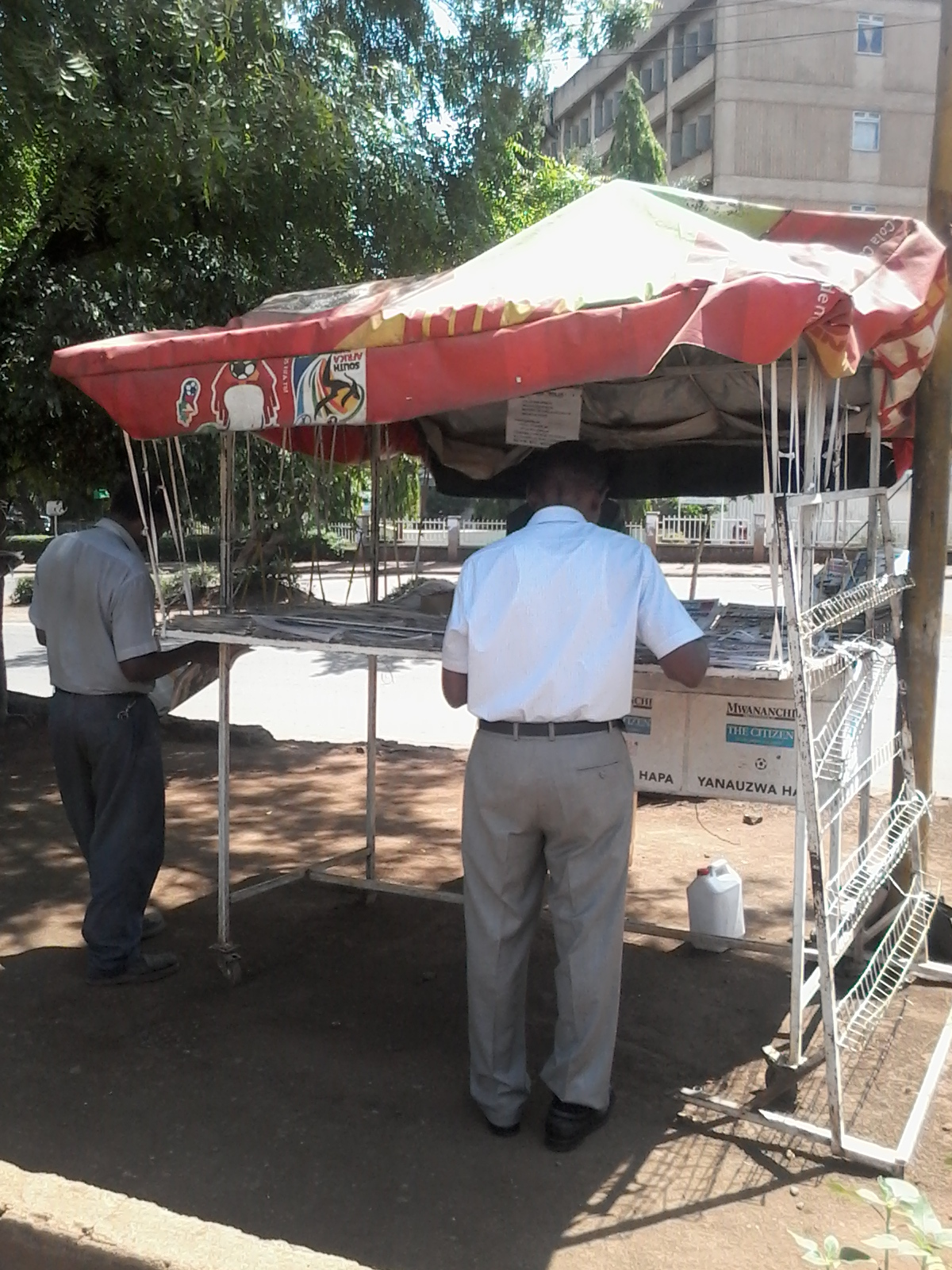
Newsstands and hawkers selling papers are ubiquitous in Moshi. Whether it is a makeshift shack or a hawker walking around with his hands full of papers, it seems to be quite a decent livelihood. The papers are dominated by Swahili publications with a few English periodicals as well. One of my favorite things of living abroad is learning more about the local context and it helps that I've already spent some time in Uganda to give me some perspective. Still, there are so many events and politics that are foreign to me and obviously the events in East Africa are sure to have some influence on me and my life.

My favorite publication is the East African (1,200 TZS / 0.75 USD), a weekly publication based in Kenya, though it circulates in Tanzania, Rwanda and Uganda. It provides professional journalism, excellent coverage, and provoking opinion pieces. I've been able to get informed about events such as a single visa for East Africa, corrupt Chinese railway management in Kenya, the conflicts in Central African Republic and South Sudan, and a variety of other issues ranging from education to health care. Because I read a lot of online periodicals, I love that it's a weekly with a focus on the region. Hopefully I'll soon be proficient enough to tackle a Swahili newspaper!


Thursday, February 6, 2014

Lake Chala

Lake Chala is located about an 1 1/2 hours from Moshi on the boarder of Kenya, with half the lake in Tanzanian territory and half in Kenya. On the Tanzanian side there is a lodge/camp and reserve on 800 hectares (2000 acres) of land with access to the lake. One of the bonuses of being private land is the lack of expensive park fees and hiking regulations. Nearly all national parks require you to have a guide at all times, even for a short walk. The freedom at Lake Chala was excellent, though not without it's challenges. 

We were brought to Lake Chala as the result of the newly formed (by Ana) Moshi Birding Club. The aim is to go out every two weeks and do a census of birds to help contribute to the Tanzanian Bird Atlas, as well as get some fresh air and see some of the natural beauty of Tanzania. Our first trip was with myself, Ana, an older British woman that has been a resident of Tanzania for 40+ years, a Masaai whom had recently graduated from a college as a tour guide, and a student whom had previously worked with some expats doing a bird census. 
Savannah across to Kenya. 
We left early and arrived by 7:30 am. During the morning we took a walk along a dry riverbed, apparently subject to flash flooding from Mt. Kilimanjaro and the surrounding hills. We ended up seeing about 40 different species of bird, two of which were the first sightings of the species (Pangari Longclaw and Pygmy Hawk). 
Dry river bed. 
There were some excellent vistas with savanna and sparse hills to the east and Kilimanjaro and hills to the west. We eventually made our way to a crater, which provided an awesome perspective to perch and scan the space below. The crater was about 1500 ft (450m) across and had a very steep drop of about 50 ft (15m) to the bottom. 

We were all relaxing when we suddenly heard the bushes rustling. It sounded like a stampede! Suddenly, about 15 ft (5m) to our left, a troop of about 100 baboons came rumbling through. They frantically climbed/fell down to the bottom of the crater and dispersed. Within the crowd there was a bushback running at full gait. Because of our angle and trees and foliage on the crater side, we didn't see exactly how the bushback got down the side. I know that I couldn't navigate down the side without falling because of the steepness, so I was impressed when I saw the bushback running across the bottom of the crater. 

After we all gathered our bearings we noticed the baboons and bushback were being pursued by a young boy, no more than 14, and a dog. We had been joined by a guide from the park who wished to learned more about birding, so he immediately dialed the headquarters to send some of their patrol. We then had a very interesting discussion about poaching and government support that seemed to indicate that corruption in wildlife management was as rampant as ever, especially with any areas not designated as official protected areas. In fact, the owner of the land has considered putting an electric fence up and, "buying a few zebras and antelope", as a result of increasing development around the area. He has been trying to lobby for a conservation corridor to allow for safe passage of animals but to no avail. There was even an incident of corrupt poaching of two male elephants last year with very suspect management of the situation by authorities. 

Looking out over the crater. 
When we finished in the morning we hiked back up to the lodge. There is camping available at the lodge as well as some luxury huts. The view from the restaurant over the lake was breathtaking! We enjoyed a cold drink and a recap of the mornings events. We then trekked down to the lake and took a swim. The water was a lot warmer than I thought it would be and a few fisherman were on the shores looking for fish. Apparently the owners have plans to install a dock, buy some canoes and provide a bit more water recreation. Either way, I'll be back to Lake Chala for a long weekend, hopefully with some camping!


Restaurant overlooking the lake. 

View from the restaurant. 

Notice the strip of green next to the lake. Beautiful environment!


View on the walk down. 

Lake side. It was pretty rocky but easy enough to find a nice spot to swim. 

Guest Entry (Ana): From Moshi to Dar Es Salaam...and back

The NGO I work for has their headquarters in Dar es Salaam and when I first started working I had to go there to meet the head of the organization. Dar es Salaam was the former capital of Tanzania, recently changed to Dodoma, and it is still the largest city (1.3 millino) as well as the economic and political hub of the country. 

When I found out I had to go to Dar es Salaam, it was suggested to me that I should take a plane. “It is almost as cheap as the bus,” people said. I disagree because you have to add transport to and from the airport (always a hooha) and, I love bus rides anyway! (ed. note: bus is about 40 USD, flight is 300 USD and 1 1/2 hours)

So I went and bought my tickets for Dar Express, one of the most well regarded companies. Apparently you can take all kinds of crappy buses but it will take who-knows-how-many hours to get there (if you even reach). With Dar Express the trip cost 25,000TZS (15.59 USD). It left Moshi at 7:00 am (I was surprised when the bus appeared at 7:00 sharp) and it took 9 to 10 hours to cover the 350 miles to Dar es Salaam.

Accidents were a major problem in Tanzania (especially with buses and trucks) so the government has recently implemented a control system. There are check points all along the road, every 50km or so, where buses and trucks have to stop and get a stamp. Further along the road there will be other check points; if the bus gets there too fast it will be fined. It is an effective system but there ends up being a jam at each of these check points, making the trip way slower that it should be. Patience, though, is what you need to have when going for a bus ride.

The trip down was pretty uneventful; the bus was nice (I would even say very nice) and people put their luggage in the storage area underneath the bus (unheard of in developing countries). We made one stop in a place with bathrooms and a bar with food. There, I had my first “Chips Mayai” (Tanzanian version of Spanish tortilla). 

The first part of the ride was very nice, as the bus drives parallel to the Esatern Arc Mountains and the landscape is awesome. After eight hours, around when I was getting tired of being in the bus, we got close to Dar es Salaam and a massive traffic jam started. I would later learn that moving around in Dar es Salaam is a nightmare. I went for dinner to a place 10 km away from the place I was staying and it took us two hours to get there and another two to come back! So, after two hours in the traffic jam we finally made it to the bus stop.
Dar es Salaam traffic jam.
My impression of Dar Express was excellent. I was happy and thereafter I decided to ride with them on my way back. Thing didn't start so good this time, though. To start with I couldn't go the day before and buy my ticket in advance (impossible to do in Dar es Salaam) so I decided to leave the house at five in the morning to try to get a ticket for the 7 am bus. The driver that was supposed to take me didn't show up (I was told later he came at 6:15) and at 5:30 I decided to take a “tuk-tuk” (little bike-car hybrid, very common in Dar). The security guard walked with me to the road (not supposed to walk alone at night) but the only transport available was a single boda-boda (motorbike). I, of course, took the boda knowing there would be some highway driving involved, which was not ideal. The driver was a very young guy, didn't know the city well, and got lost two or three times... but we finally made it to the bus station at 6:15 (after parking the boda and walking through the traffic impenetrable to even a boda).

The bus station in Dar es Salaam is huge, chaotic and didn't make any sense to me. The driver was becoming annoyed with the tenuous journey and wanted to leave but I didn't even know where to look for the ticket office. A tourist harasser showed up (guess I was looking pretty lost) and I had to surrender to him guiding me if I ever wanted to make it to the bus. We found the company's office and, of course, there were no tickets for the 7 am bus. The first one was at 9:00. I bought the ticket and the guy walked me through hundreds of buses, parked in no apparent order, to the place where the Dar buses departed from. I gave him 200 TZS (0.12 USD) and started looking for tea since I had two hours to wait and hadn't had breakfast yet.
Dar es Salaam bus park
I sat in a local place and had tea and some food, killing some time reading. At 8:30 I walked to the departure spot and was kind of surprised when I saw the bus wasn't there. I asked people around and everyone seemed to be waiting for the same bus, so I just sat down and got ready to wait. At 9:15 the bus still wasn't there and people were getting nervous. There was a group of courageous young women that were harassing the drivers. When they came back grumbling I asked them what was going on (since everything was happening in Swahili) and they said nobody knew where the bus was, or if there was even a bus. It didn't look good!. At this point it started to rain, the only shelter was a tree, naturally one with very few leaves and cover...I was feeling miserable.
Dar es Salaam bus park
There were two nuns that asked me what was going on. They were coming from Zimbabwe to attend a meeting in Arusha. Their entire trip had been a disaster and they kept saying there was a Jonah and one of them needed to be eliminated. The Jonah is traditionally a person that brings bad luck to ships; mariners used to throw water at whoever they considered to be the Jonah to break the curse. Good to know it was one of them who was the jinx! The women kept getting more and more nervous; they thought there was no way we would make it that day. "Disaster!" one of them was shouting. The drivers were hiding at this point, and the last thing anyone heard from them was that the bus would come at 10:30. The company had already sold tickets for the next bus, which was leaving at 12.

At 11:00 the bus wasn't there, I was all wet, tired and hungry, and I was thinking what to do if we really couldn't make it out of Dar es Salaam. Too late to find another bus, didn't want to spend the night in Dar es Salaam, and the house were I was staying was pretty far away. Should I stay somewhere close to station? I could foresee having the same problem trying to reach the station early enough if I went back to the place I was staying. I was immersed in these thoughts when someone shouted something in Swahili with a happy tone... I looked up and...the bus was coming!!! Finally we left Dar at 11:30 ready for a long trip...

The trip was long, we were stuck in traffic for a while, same as usual. At five I was kind of tired and started asking how far where we. Four hours to Moshi (not bad, we'd make it by 9 pm). I thought we were skipping the break. Disappointingly we stopped about an hour later for 20 minutes though everyone was hungry at this point. When we were back in the bus I asked again how far of Moshi were we, four hours was the answer. I started to suspect this timing was not very precise. In the end we arrived to Moshi around 11:00pm. After everything, I was happy to be back, but I'm now ready again to take the bus to Dar!


Saturday, January 25, 2014

Backyard wildlife

I'm always surprised when a non-Wisconsin native visits my home state and shows excitement over the abundance of squirrels and deer. Although Wisconsin has nowhere near the exotic species of Tanzania, it likewise excites me to see new wildlife. I've been pleasantly surprised by the variety of species found in my yard. I was inspired to write this today as a result of the Baglafecht weavers outside our window.
Male Baglafecht weaver, female in the upper right. 

The nest outside our window. 
Safety of the bushes. 
There are several weavers in our yard; the avocado tree is covered with nests and their calls are heard constantly. They are a beautiful bird, build interesting nests, and one of them has a nest directly outside our window and recently had a chick hatch. We can hear it cry out and get a good view of the adult feeding it, all pretty good stuff. Well, today the chick exited the nest for the first time and when it dropped the 6ft to the ground, it was quite stunned. It found itself boxed in by a cement wall (see picture above). The adult had food in its mouth and was calling the chick to jump over the wall and join her in the safety of the bushes. After a few attempts, it finally made it over the wall and into the bushes with its mother. The whole scene was very National Geographic and reminded me of spring time back in Wisconsin. 

Birds are numerous in our yard, I've tallied 30+ different species in the yard, some permanent residents, some just passing through. My two favorite regulars are the Speckled Mousebird, and the Cordon Bleu. The Cordon-bleu is a gorgeous pastel blue, pretty small, and spends a lot of time on the ground hopping around. The Speckled Mousebird is pretty cool because not only does it have a mohawk (crest in bird language) and a long tail, but it perches in a very peculiar way (see picture). The mousebirds kind of remind me of an orangutan the way it swings on the branches with its legs.  
Red cheeked cordon bleu. 

Speckled Mousebirds perching. 
There has also been a resident four toed hedgehog in the yard. This guy's nocturnal so you can hear him poking around at night. They are very slow so if you can get a good view of them.
Four toed hedgehog, named for the number of toes on the hind legs. 
There has also recently been a slender mongoose stalking around. It's not nearly as cute and much more skittish than the hedgehog.
A slender mongoose. There are over 50 subspecies in Africa. 
There are also squirrels here, though they are much smaller and more rodent-ish than the Wisconsin variety. There has also been an influx of bats due to the arrival of the mango season. You can hear them fluttering in the branches and breaking off mangoes in the night. In the morning there are half eaten mangoes strewn on the ground.

Unfortunately, there is also quasi-domesticated urban wildlife like cats and dogs. I absolutely despise feral dogs and have no problem throwing stones at them to drive them out of the yard. From years in developing countries I've been trained to drive them away and all of them react to motion of bending over to pick up a stone by running away as fast as possible. I don't plan on taking any more drastic actions against the dogs...that is, unless they dare bother our resident hedgehog! 

Saturday, January 18, 2014

Food: Bananas 101

Four different types, or cultivars, of bananas. 
One of my readers asked me some questions about my recent entry, "Money: Tanzanian Currency". More specifically, though it had little to do with the entry, my reader asked me what a "hand" of bananas was. I realized bananas were something that have always been available to me but since moving to the tropics I've learned so much more about this ubiquitous fruit. I remember my amazement when I first moved to the tropics and tasted the many different types; from small and creamy to huge and starchy. Plus, bananas were one of the first plants domesticated by humans some 10,000 years ago in SE Asia, so there is definitely some institutional memory and familiarity with human beings and bananas.
Musa balbisiana, one of the ancestors of the edible bananas. Modern cultivars of banana are parthenocarpic (seedless) and are propagated asexually from offshoots. The plant typically produces two shoots at a time; a larger one for immediate fruiting and a smaller "sucker" or "follower" to produce fruit in 6–8 months. Often these are chopped off with a machete and planted nearby. 
Sadly, in the Western world we typically only import one cultivar of banana, the cavendish, even though there are 1000's of varieties worldwide. The New York Times wrote an excellent article a few years ago that I frequently cite, titled "Yes, We Will Have No Bananas", which takes a look at the history of banana production, the reason for a mono-culture of bananas, and the possible collapse of the industry as  result of disease and pests. If you want more, here is another more recent excellent article from the New Yorker discussing blight.
A "bunch" of bananas on a plant. 
Cavendish banana "hands." One of these would be a "finger", though I don't know any place that uses "finger" as the colloquial. I think I'll start it, "I'll have two apple and a finger". 
I digress... I'll try to respond to my reader. To answer the original question, a "hand of bananas" comes from banana "bunch", which consists of "hands", and each hand has "fingers". It's common for people in developing countries to eat bananas green (typically boil or roast). After all, a bunch of bananas is huge and would spoil quickly if they were all ripe. Unripe bananas have more iron, but ripe bananas have more potassium and sugar. Unripe bananas are not commonly eaten raw. For most of you western readers, your bananas are picked green and later ripened with ethylene gas. 

To further confusion, many places eat "plantains". These bananas are much bigger than most banana varieties and typically treated more as a starch than a fruit. They can be prepared unripe, usually boiled or roasted, or enjoyed ripe, mainly fried. Unfortunately, unlike most bananas, they are unsuitable for raw consumption. Although I have seen it some places, it's not preferred and can give you indigestion. 

One of my favorite things about plantains is they can be fried even if they overripe and black and mushy. It's nice to have access to a bunch of plantains and slowly eat them as they transform through the stages of starch to sweet. 


Bunch of plantains. Notice the pointed ends and narrow shape. 

Plantains at varying stages of ripeness. 
Caramelized fried plantain. Yes, please.
For some reason I was under the impression that plantains and bananas were two seperate species, but I recently learned there is no botanical difference between 'banana' and 'plantain'. Plantain is just a different cultivar. All modern bananas are descendants of the wild species, Musa acuminata and Musa balbisiana. Thus, bananas are classified by those primarily exhibiting the botanical characteristics of Musa balbisiana (B), those primarily exhibiting the botanical characteristics of Musa acuminata (A), and those with characteristics that are the combination of the two. There are eleven groups with names like: AAA, AAB, AB, BBB, and ABBB. The cavendish, the most common in the Western world, is AAA. 

Arsenal of small bananas.  
This is like a police line-up in the world of fruit. 

Bananas can be all different colors. 
While working in Nigeria, I visited a friend working for the International Institute of Tropical Agriculture (IITA). She was well versed in botany and had a tree nursery at the facility. She happened to have a catalog from a banana cultivar supplier with a variety of bananas I had never imagined existing. Subtleties in taste, needs for growing conditions, and economic viability were all endorsed in this stunning catalog. 

And to imagine, most types of tropical fruits, from pineapples to mangoes, have this type of variety. I always tell people, fresh fruits and vegetables are one of my favorite things of living in the tropics! 
The thousand finger banana cultivar. I don't believe any additional comments are necessary.