Wednesday, February 26, 2014

Laundry hazards

I used to despise doing my laundry by hand, but after some years I now find it to be part of my routine and if in the right mood, even relaxing. It's a routine for me to do my laundry every Saturday morning (Sunday if it rains) and I like it because I have the exact amount of underwear and work clothes to last me the week. If clothes aren't regularly worn in the tropics, they are at risk of growing mold. Plus, not having a heaping pile of laundry makes the task less daunting and time consuming. It usually only takes me about a 1/2 hour to hand wash my clothes in the morning.

Another thing I love is hang drying my clothes. For some reason it feels oddly rewarding when my clothes have dried to a crisp after a day in the sun. Ana is more at home with hang drying as it's widely practiced in Spain; she's never even SEEN a house with a dryer in Spain. I obviously like the fact that it is taking advantage of a renewable energy, especially in comparison to how much energy it takes to run a dryer.

However, there are hazards with hang drying. First, the threat of rain can be serious, especially since I have the exact amount of clothes I need. Clothes will eventually dry when hung inside and if there is a true need, you can always dry clothes out with an iron. A second hazard is that people love to have fires here, whether it's for burning brush from their small shamba (farm), or burning their trash as there isn't an adequate trash collection service. There is always the risk of your clothes smelling like a camp fire when you're done, which is a wonderful in comparison to when they get smoked out by a burning trash pile; the smell of burning plastic is difficult to get out.

I typically have good luck with my clothes but the other day our landlady had some people do work on the shrubs around the yard. As you can see, I was victim to getting my clothes smoked. Fortunately, the winds were kind and my clothes only smelled faintly of burning bush.

Transport: New Motorcycle!

This style of bike is ubiquitous in Tanzania. 
I recently purchased a 150cc motorcycle, greatly increasing my mobility and providing me some much needed freedom. This will especially help since I'll be moving this weekend and I'll be much further to my workplace than I am now. It will also allow for more day trips and travel around Kilimanjaro and Moshi region and hopefully the circumnavigation of Africa :-)

The roads here are not too congested and motorists tend to drive defensively, at least relative to developing countries. The only big drawback is the rainy season, but I learned in Nigeria that with a good poncho, you can brave nearly anything.

I'm also curious to see the level of bribery here with the traffic police. I often see the police out at their checkpoints with their signature all white uniform, but I've never been in a vehicle that has been stopped. I'm a bit nervous because my resident permit has not yet processed so although the bike is registered and insured, it's in someone else's name. My license is also an international drivers license since I need my permit to get a local one. None of these issues is technically a problem but traffic police only need the slightest irregularity to hassle you. I once rode in a taxi in Uganda with a Kenyan driver that moved goods from Kenya to Sudan. After wasting about 30 minutes successfully wrangling their way out of a bribe, I asked him which country had the worst traffic police. He laughed and simply said, "All traffic police come from the same mother". 

Friday, February 21, 2014

Swahili 101: Noun classes

It's been about three months and I've been working hard to learn Swahili. When I first arrived many foreigners claimed it was "an easy language", though at this point I'd politely disagree. I've written a brief overview on Swahili in a previous post, so I want to introduce some of the language in this post.
Map of where Swahili is spoke in East Africa. 
Swahili has a lot of loanwords due to the amount of Arabic influence on the language. It also has many loan words from Indian languages, Portuguese, Persian, and increasingly more in English. The number of loanwords is fairly comparable to English’s use of Latin and Greek.

The pronunciation is almost identical to Spanish, so that's a huge bonus for me as I've already studied Spanish. It's also similar to Spanish in that there are no "hidden" sounds, meaning that once you know how to pronounce the alphabet, you can theoretically read any Swahili words with accurate pronunciation.

There's a few basic things that make learning Swahili  difficult for native English speakers. It’s use of a wide group of classes for words, which are denoted by prefixes such as m- and n-, can be a difficult thing for some English speakers to get comfortable with. While essentially the same as the gender system used by some European languages, the Swahili class system is both larger than what most Romance speakers are used to and less arbitrary in its assignment.

For example, nouns belong to any number of nine noun classes. I'll give two examples.

The first noun class I'll explain is the M/WA noun class. This is typically comprised of "people" words, such as child, which is mtoto for singular, and watoto for plural. A second group is KI/VI, which doesn't really have a concrete pattern with words for languages, onions, a bed, and matches all grouped in. Bed is kitanda and beds is vitanda. Many of these noun classes have sub classes which further complicate things. For example, in the KI/VI class, words that begin with CH take a VY for their plural form. So the word for room "chumba" becomes "vyumba" for rooms. This system wouldn't be so bad if all the words began with the letters of the noun class, but they are often mixed, which means you simply have to memorize which class words belong to and adjust accordingly.

One of the most challenging things about Swahili and the noun classes is the overwhelming amount of other grammatical rules that apply to each noun class. For example, demonstratives such as "this, that, these, those" are different depending on what the noun class is. So if we use a M/WA class noun, "That child" is "yule mtoto" and "this child" is "huyu mtoto". But if we use a KI/VI class noun, "That bed" is "kile kitanda" and "this potato" is "hiki kitanda". Of course if you want to make either of these plural, you have to learn a new article AND change the prefix to the noun (ex. "these children" is hawa watoto).

As if this wasn't enough, you must modify certain parts of speech depending on the noun class. For example, adjectives and numbers take the prefix of the noun class. Thus, when you're looking in the dictionary for the word "big", you'll see "-kubwa", which denotes that you must include the prefix from the noun class. Same goes for the numeral "four" which is "-nne". Further complicating things, not every adjective or numeral needs to have a prefix change. For example, numerals one through nine are conjugated, with the exception of six, seven, and nine. Numerals higher than nine are not conjugated.

Four big children = Watoto wanne wakubwa.
A big child= Mtoto mkubwa.

Four big beds= Vitanda vinne vikubwa.
A big bed=Kitanda kikubwa.

Although there are some similarities in Swahili grammar and English grammar, the differences are very tough for a non-native English speaker to get over!

Local hairstyle names

When I lived in Jamaica I remember thinking it was hilarious when I learned they called "corn rows" a more appropriate "cane rows" due to the prevalence of cane sugar. While I'm not sure what they call them in Tanzania, I did stumble on another culturally appropriate name for a hairstyle.  
Sugar cane row. 

Corn row, of the non-hair variety. 


Corn or cane row, depending where you come from. 
A popular way to cane row is to have the rows come together in the back at the top of the head. While in Nigeria I learned this was called the "pineapple" due to its resemblance to said fruit. I learned that in Moshi they call it "Kilimanjaro", while in Arusha they call it the "Meru". Each of these is named for the respective mountains that serve as the backdrops to the cities. It makes me wonder if we have a name for this style in America? Perhaps those in Portland call it the "Mt. Hood"? 
Kilimanjaro hair style. 

Saturday, February 8, 2014

Food: Pilau

A proper pilau cooker. 

The top is removed to reveal the delicious pilau. 

Cooks can stir it with a spoon the size of a canoe paddle. 


I've already mentioned this dish in my blog and it's no coincidence that it's one of my favorite Tanzanian dishes. The dish is Indian in origin and symbolic of the rich cultural mixing that has occurred in Tanzania for centuries. Pilau is a rice dish flavored by cooking with beef stock, and adding spices and meat or seafood. The most basic pilau has spices and beef, but other vegetables and meat can be added. The spices are a mix of black pepper, cardamom, cinnamon, garlic, and cloves, though the "recipe" can vary. People usually buy a pre-mixed "pilau spice" at the market or supermarket but as you can imagine, the good stuff is "home-mixed".
This is about the most basic pilau you can have. About 1,500 TZS (0.95 USD) worth. 
As mentioned in my earlier entry, pilau is traditionally prepared at Christmas and other special occasions like weddings and birthdays. It's also a traditional dish to have on Sundays. In Moshi, pilau is available at most high end restaurants with local places reserving availability for weekends. It should also be noted that many people prefer to eat it by hand, claiming it to be a "sweeter" eating experience. It's hands down my favorite Tanzanian dish and I haven't even had an elaborate homemade pilau (see below). Hopefully soon...
I'm convinced pilau is the East African version of paella. This pilau is a high-class pilau. 

Another loaded pilau.


Friday, February 7, 2014

Newspapers and Media: The East African

UPDATE: In January 2015, the Government of Tanzania banned the periodical, The East African. 


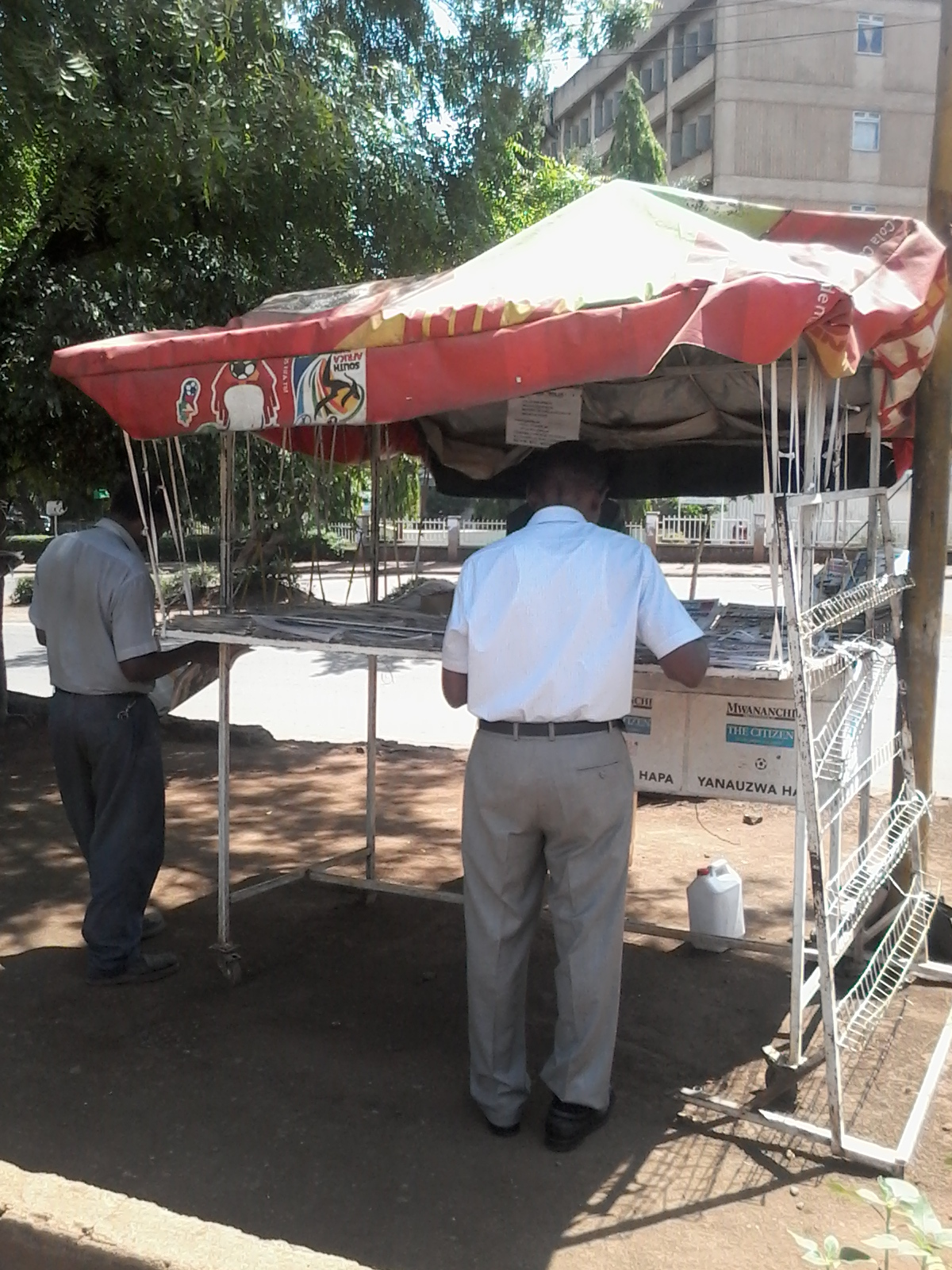
Newsstands and hawkers selling papers are ubiquitous in Moshi. Whether it is a makeshift shack or a hawker walking around with his hands full of papers, it seems to be quite a decent livelihood. The papers are dominated by Swahili publications with a few English periodicals as well. One of my favorite things of living abroad is learning more about the local context and it helps that I've already spent some time in Uganda to give me some perspective. Still, there are so many events and politics that are foreign to me and obviously the events in East Africa are sure to have some influence on me and my life.

My favorite publication is the East African (1,200 TZS / 0.75 USD), a weekly publication based in Kenya, though it circulates in Tanzania, Rwanda and Uganda. It provides professional journalism, excellent coverage, and provoking opinion pieces. I've been able to get informed about events such as a single visa for East Africa, corrupt Chinese railway management in Kenya, the conflicts in Central African Republic and South Sudan, and a variety of other issues ranging from education to health care. Because I read a lot of online periodicals, I love that it's a weekly with a focus on the region. Hopefully I'll soon be proficient enough to tackle a Swahili newspaper!


Thursday, February 6, 2014

Lake Chala

Lake Chala is located about an 1 1/2 hours from Moshi on the boarder of Kenya, with half the lake in Tanzanian territory and half in Kenya. On the Tanzanian side there is a lodge/camp and reserve on 800 hectares (2000 acres) of land with access to the lake. One of the bonuses of being private land is the lack of expensive park fees and hiking regulations. Nearly all national parks require you to have a guide at all times, even for a short walk. The freedom at Lake Chala was excellent, though not without it's challenges. 

We were brought to Lake Chala as the result of the newly formed (by Ana) Moshi Birding Club. The aim is to go out every two weeks and do a census of birds to help contribute to the Tanzanian Bird Atlas, as well as get some fresh air and see some of the natural beauty of Tanzania. Our first trip was with myself, Ana, an older British woman that has been a resident of Tanzania for 40+ years, a Masaai whom had recently graduated from a college as a tour guide, and a student whom had previously worked with some expats doing a bird census. 
Savannah across to Kenya. 
We left early and arrived by 7:30 am. During the morning we took a walk along a dry riverbed, apparently subject to flash flooding from Mt. Kilimanjaro and the surrounding hills. We ended up seeing about 40 different species of bird, two of which were the first sightings of the species (Pangari Longclaw and Pygmy Hawk). 
Dry river bed. 
There were some excellent vistas with savanna and sparse hills to the east and Kilimanjaro and hills to the west. We eventually made our way to a crater, which provided an awesome perspective to perch and scan the space below. The crater was about 1500 ft (450m) across and had a very steep drop of about 50 ft (15m) to the bottom. 

We were all relaxing when we suddenly heard the bushes rustling. It sounded like a stampede! Suddenly, about 15 ft (5m) to our left, a troop of about 100 baboons came rumbling through. They frantically climbed/fell down to the bottom of the crater and dispersed. Within the crowd there was a bushback running at full gait. Because of our angle and trees and foliage on the crater side, we didn't see exactly how the bushback got down the side. I know that I couldn't navigate down the side without falling because of the steepness, so I was impressed when I saw the bushback running across the bottom of the crater. 

After we all gathered our bearings we noticed the baboons and bushback were being pursued by a young boy, no more than 14, and a dog. We had been joined by a guide from the park who wished to learned more about birding, so he immediately dialed the headquarters to send some of their patrol. We then had a very interesting discussion about poaching and government support that seemed to indicate that corruption in wildlife management was as rampant as ever, especially with any areas not designated as official protected areas. In fact, the owner of the land has considered putting an electric fence up and, "buying a few zebras and antelope", as a result of increasing development around the area. He has been trying to lobby for a conservation corridor to allow for safe passage of animals but to no avail. There was even an incident of corrupt poaching of two male elephants last year with very suspect management of the situation by authorities. 

Looking out over the crater. 
When we finished in the morning we hiked back up to the lodge. There is camping available at the lodge as well as some luxury huts. The view from the restaurant over the lake was breathtaking! We enjoyed a cold drink and a recap of the mornings events. We then trekked down to the lake and took a swim. The water was a lot warmer than I thought it would be and a few fisherman were on the shores looking for fish. Apparently the owners have plans to install a dock, buy some canoes and provide a bit more water recreation. Either way, I'll be back to Lake Chala for a long weekend, hopefully with some camping!


Restaurant overlooking the lake. 

View from the restaurant. 

Notice the strip of green next to the lake. Beautiful environment!


View on the walk down. 

Lake side. It was pretty rocky but easy enough to find a nice spot to swim.