Friday, March 17, 2023

Camp hazards: Acacia thorns


Ouch.
 

Acacia trees are one of the biggest hazards of bush life. There are a variety of species but all of them have thorns in various shapes and sizes, some are hooks while others are spear shaped. Regardless of their shape, all of them can easily tear clothes, scratch faces, and pierce the bottom of even the sturdiest shoes. In the dry season the trees are dry and thus the thorns are hard and inflexible. In the rainy season as the tree retains more water the thorns can actually be flexible and although they are still sharp they are not nearly as piercing.

I spend a lot of time in flip flops and the above photo shows the dangers of this. Acacia trees shed their branches and it's common to have the ground littered with thorny branches of various sizes. They can not only pierce the shoddy flip flops but I've had them pierce the soles of my Merrell hiking shoes! The worst is when you break off the thorn trying to remove it and then you're left with an embedded thorn that only pokes you when applying a specific amount of pressure like when running or climbing stairs. 

You might notice that many of my camp clothes also have small tears and holes. These are undoubtedly from being snagged on branches which is unavoidable. It's one of the reasons I have bush clothes! It's also not uncommon to see us with scratches on our face and our arms and a tell-tale sign someone has had a bush expedition. 

It has taken some adjustment but now we are very careful when moving through the bush and I hope that we've reduced the amount of shoe-piercing and face-scratching incidents but the hazards still remain! It is one of those things that you have to experience to really take care; one brand new shirt ripped wide open, a seemingly innocuous branch that brushes your face and draws blood, or a harmless branch that pokes through your shoe leaving you hopping around on one foot. Everyone's gotta go through it to learn their lesson!

This species of acacia can seriously impale someone


Saturday, March 11, 2023

The birds nest


African Paradise Flycatcher (Terpsiphone viridis)
 

We are lucky enough to be set in a relatively wild environment and one thing we love is the birdlife. Birdwatching is a really fun hobby and one that I wish I would have taken up earlier in life but I'm happy to be in a place where I can "birdwatch" every day. Each morning we wake up to the chorus of bird calls and over breakfast we like to watch the various species of bird drink and bathe in our birdbath. Over the years we've gotten familiar with all the birds in our area and we particularly enjoy watching the families grow during breeding season. Every year our camp is littered with nests and we usually get one close to our banda. This year we had an African Paradise Flycatcher, one of my favorite camp birds and one that is not a resident. They only show up during the rainy season from November to May before moving on to other parts of Africa. 

This year one couple made a nest very close to our banda. In fact it was within perfect viewing range (see below) which was highly entertaining for our camp life. We watched the birds slowly build the nest which was truly a team effort. They build very compact small nests from twigs, feathers and whatever else they can get their beaks on. After they lay their eggs they take turns incubating and this was also a delight to watch as the defended their nest from other larger birds and smaller mammals like mongooses. After the eggs hatched they were then constantly feeding their chicks. Watching the African Paradise Flycatcher in flight is always a treat with its long streaming tail and wavy dolphin-like oscillations. With chicks to feed it is constantly hunting and in turn a constant distraction when I am working outside. 

Unfortunately this story does not have a happy ending. One morning I saw the nest was hanging loosely from the branch. I went to investigate and saw the nest was loose with no chicks in sight. I do not think they were quite ready to leave the nest and thus I think a mongoose, genet, civet or some other critter got them in the night. Mother nature can be ruthless!

You can see the table on our porch, the red circle is where the nest was.


First the eggs
Then the chicks


Food: Honey

Eating the honey off the palm of the hand, or the spoon, or a cup

Big 'ol bucket of honey. And you better believe there are a ton of bees and wax in there .


In many rural areas and within traditional cultures, honey is still hugely valued. Wild honey is commonly foraged in most of Tanzania and among one of the tribes that we work with it is still used as part of the dowry offering in marriage. It is also used to pay fines within the culture (for various cultural transgressions), as a bargaining item in exchange for livestock, as well as being a fixture at cultural events such as funerals or weddings. As with many cultures around the world, it is also fermented to make a honey wine but it is also commonly consumed raw. And when I say consumed raw, I mean, palmed like a bear and licked clean. I recently found myself at a homestead that had recently procured a few kilograms of honey. 

I was invited inside due to the recent arrival of a couple of literal buckets of honey. My host was excited to invite me in to join the consumption. I could not ascertain for which reason the honey was procured but the mood was cheerful. I was surprised at the huge bucket of honey, full of debris such as wax, bark, and dead bees. But I was truly shocked at the rate of consumption which I observed; young men were scooping huge portions of honey into their palms and then slurping it up before dishing out more which resulted in something I could only accurately call a feeding frenzy. I was given a small bowl with an enormous amount of honey, probably at least a half kilogram (1 lb.). Although I do enjoy honey I almost always consume it as a spread on toast. I have been known to enjoy a spoonful here and there but I am certainly not accustomed to eating such a large volume in one sitting. 

Luckily I have more than enough experience in this type of situation. As a result of living and traveling in several different countries across the world, I have learned to tell the difference between a situation with escape possibilities and an inescapable situation. If provided with coagulated goats blood garnished with cilantro (as the Mapuche in Chile offered me) or the eye of a steamed fish (as is customary in China for the guest of honor to begin with to signal the beginning of a feast) I've known that must suck it up in front of the huge crowd and do my best to consume with a smile on my face. If faced with a grisly piece of fat from a day old un-refrigerated piece of meat in a homestead, I can usually locate a hungry dog or pawn it off to a willing child. In this case I knew I had to consume a fair bit of honey but I was pleased that when I informed my host that I was satiated, he gladly yanked the bowl from my hand and slurped down the remains.

One of the most common ways to forage for honey is to look for it in Baobab trees. Honeybees are fond of the crevices in the huge trees. Honey hunters tend to reuse specific trees and it's not uncommon to find pegs riddling the trunks of the Baobab trees.

A typical Baobab tree with climbing pegs to collect honey

This story actually took place in October 2017 but I was recently perusing some old photos and I remembered it.

Sunday, February 26, 2023

CNG conversion for cars in Dar es Salaam


View from the back.

When I called for an Uber in Dar es Salaam the other day, I was shocked when I opened the trunk to reveal a gigantic compressed natural gas (CNG) cylinder.  I immediately assaulted the driver with questions and he was kind enough to share that installation was around $770 to $900 to install. The cylinders were available in the city for $7.28 (11kg). He said they were not available everywhere so one has to plan in advance but he didn't feel it was an inconvenience. He estimated that he could get 180-200km from each tank. He also said that the original petrol system remains in the vehicle so if the cylinder ran out he could continue to drive.

We rode with one other driver that had installed the system. I asked other drivers that did not have CNG if they had heard of it and if they planned to install. Many of them said the initial installation fee was cost prohibitive and almost all of the drivers alluded to the possibility that the incumbents profiting from the petroleum industry were not encouraging of this transition. The drivers would be excused for confusing me with a CNG salesman doing market research but I was truly fascinated. I did a little research and saw that Tanzania has national natural gas production and a pipeline that extends from the south to Dar es Salaam. This would explain how the local industry can be competitive and bodes well for sufficient energy production and reducing dependency on imports. 

We did several back of envelope calculations with drivers based on their reported fuel economy. We estimated that it would take 15,000km traveled before the initial investment was recouped. Most of the drivers reported that this would take six months to one year based on their daily driving. If I was less occupied with my day to day job and more entrepreneurial, I might be tempted to drop everything and invest in the CNG business in Tanzania. As the middle class grows and vehicle ownership increases, the costs of fuel are one of the first shocks to first time car owners. I hope that CNG conversion becomes more popular and widespread as it would support both the Tanzanian natural gas industry and reduce emissions and dependency on imported petroleum products. 

EDIT : A week after I saw this article about growth in the industry 

Chameleon Season

Resting color.


After I've handled the above individual it turned a much darker color.

The rainy season provides a breath of life to many different species of plants and animals. One of my favorites are the chameleons. In our area there is only one species, the Flap-Necked Chameleon (Chamaeleo dilepis). During the rainy season they become much more visible and it's not uncommon to see them crossing the roads while driving. They are fascinating creatures that move with an odd gait and their famous eyes move independently of each other, adding to their weirdness. Growing up I had heard that they can change colors and camouflage themselves but this is only half true. They can range from bright green and yellow to dark brown but I wouldn't say they have camouflage abilities, at least certainly nothing like octopuses. It's still neat to see them change color though it is usually a sign that they are stressed out (which is typically from me handling them, sorry guys). What can I say, I can't help myself but to pick them up every single time that I see them. I love feeling their herky-jerky movements as they scramble up my arms and often onto my head. Contrary to many local beliefs, they are not venomous nor dangerous. Their claws can scrape and they can bite though I have never suffered a skin-piercing wound or anything close. 

One of the coolest things I've ever seen is when I was shown how to scan for them at night. My late friend and extremely knowledgeable safari guide from Zimbabwe once showed me at night how to scan vegetation for their presence. His ability to identify them was uncanny, downright scary. We'd be in the dark with a single head-torch and he'd identify tiny individuals under blades of grass. He explained that once you start looking for them and get familiar with their tell tale reflections and how they "disrupt" the normal vegetation patterns, well, then it's easy. It's a skill that I have tried to sharpen over the years but unfortunately I am usually simply wandering about, squinting at the grasses, likely passing over dozens of chameleons.

Very small

Very large.

One of the brownest ones that I have ever seen, clearly trying to blend in.


Saturday, February 25, 2023

Locally manufactured clothes

The current trousers of the year
 

I've written about some aspects of the clothing industry here (second hand 'bale' import shop, second hand 'bale' auction, second hand market) but one aspect I have not covered is locally produced clothing. Tailors are ubiquitous in Tanzania, especially in urban areas as they don't need an office rather they can simply move their foot-powered sewing machines and clothe to anywhere they please. It's not uncommon to see them strewn about the city in front of random shop fronts. School uniforms are a big part of their business but many people use them for full gowns and outfits, especially for special events like weddings. It's common for weddings to have coordinated custom tailored clothes for the wedding parties. I have used these tailors mainly for repairs which is something I absolutely love. Small things like broken zippers, holes in pockets, and loose stitching are a convenient and cheap service offered. 

On a slightly higher level are clothes that are mass produced somewhere in a mass manufacturing facility. This is most evident for me when it comes to trousers. Sellers in Iringa randomly go through different phases where everyone has the same brand of trousers. Two years ago it was, very randomly, Jeep brand. They even had a metallic shield that was stylishly sewn onto the rear of the trousers but to the best of my knowledge the vehicle maker does not have an official trouser manufacturing subsidiary. How these brands and names are chosen? Who knows, but the result is the proliferation of a new brand each year, which is possibly the same manufacturer. I realized how successful they are when I saw that four of the men in my workplace had the exact same trousers as me! They fit well but the stitching and quality of the trousers is not the greatest quality. However, I'm happy to support the local industry and the environment is so tough on my trousers anyway that not even high quality trousers stand a chance at long term survival!

The classic human powered sewing machine and street set up.


Sunday, February 19, 2023

Driving in Dar es Salaam

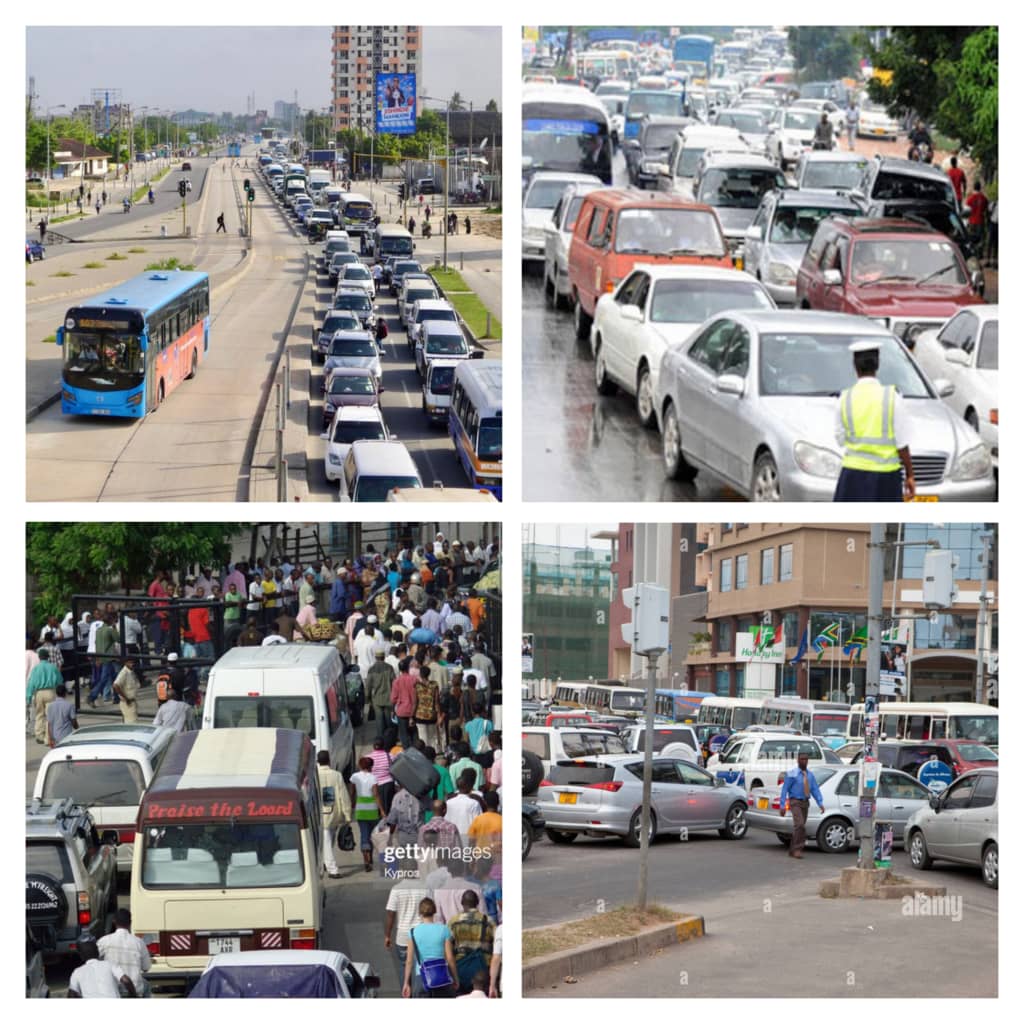
Upper left is the "mwendokasi" public bus and a collection of representative Dar es Salaam traffic photos

One of my least favorite things in Tanzania has to be driving in Dar es Salaam. Dar es Salaam is a large city with around 7 million people. I am nearly always based in a 50 km2 (31 miles) grid and inside those areas there are only a few multi-lane roads. These leads to densely occupied roads of not only cars but also bijajis and most hectic, the motorcycles. This does not account for the men dragging two wheel carts by hand, pedestrians, traffic police, construction teams, public transport conductors, truly an endless variety of transport means and methods. 

To make things worse for myself, I'm used to the sleepy Iringa traffic. Heck, we don't even have a traffic light in Iringa town. So when I arrive to the bustling Dar es Salaam and cut-throat traffic maneuvers, I'm often left initially aghast like some old granny trying to slowly merge into a lane only to have continuous flow of aggressive drivers cutting her off. It takes a moment to get into the Dar es Salaam mindset until it shifts so far along the spectrum that you need to again remind yourself: better to be slow, but safe. The last thing you want is to be involved in a fender bender or minor scratch. Insurance providers here are notoriously dodgy and unless it's a very serious accident it's the norm to simply negotiate with the other driver. Depending on your perceived culpability and the others drivers approach (fair dealing or milk for all its worth?), this can be an incredibly stressful and difficult situation to deal with.

The other day I had a rather "normal "Dar es Salaam drive that I felt was totally representative of the perils one faces on the road here. 

I drew a box around the area of what is Dar es Salaam proper (
Total area: 52.79 km² (20.38 mi²)
. The little bit jutting out is called the Peninsula and it's the most affluent area of Dar es Slaam.

I was picking up a vehicle from near to the Tazara Railway, which is on Julius K. Nyerere Rd, one of the main veins running from the airport to downtown, to Rose Garden in Mikocheni, a neighborhood in the north of the town. I would have to basically cross through the city but not necessarily pass through downtown. This is a 15km (9.3 miles) route that Google Maps predicted would be 30 minutes. If you want to have an indicator of mobile phone and data penetration in emerging markets, Google Maps traffic accuracy may be a good proxy. And you will see that Google Maps has no idea how to estimate drive times in the chaos that is Dar es Salaam. 

Even before my journey I faced one of the common challenges on the road here. On my way over we were stopped for 15 minutes to allow for a government dignitary to pass. This happens all over Tanzania for a variety of politicians from the president to local ministers. It's often a flex of power which is extremely annoying as smaller dignitaries frequently cause traffic to stop for up to a half hour. I had annoying chosen a motorcycle taxi and was left roasting in the sun on the open road which possibly primed my state of mind for the upcoming journey. It was kind of cool when the motorcade passed and a fleet of motorcycles at the front of the line took off like the start of a racing event. I felt like I was either in a race or part of a biker gang with literally dozens of motorcyclists eager to hit the open road after the long wait.

My journey started at 3pm, which I thought was enough time to avoid the major traffic exodus from downtown outwards. However, immediately after turning onto a main road I was stuck behind a long line of lorries. Massive trucks with trailers and containers clogged up the road and it took 10 minutes to merge onto the main road. After finally merging I was immediately at a standstill for 5-10 minutes. There was an overpass being constructed at the intersection so you can imagine how congested that intersection was if it necessitated an overpass and now it was under construction. Trucks creaked through and traffic police directed the traffic as hustlers touts weaved in and out of traffic hawking wares. 

I love the variety of wares the hawkers have and I often feel like there are distinct trends and gluts of randomly specific products. The current item of the month were weird Asian style knives that had a sheath, something a ninja in a low budget movie would have. The touts are a subject I should cover in a separate post as the world of the street touts is fascinating. There are also disabled folks and street children begging for money, as well as an increasing amount of uninvited window washers. They are nowhere near as extortionate or aggressive as some other cities in the world but it can still lead to an uncomfortable experience. 

After about a half hour and half kilometer I was still stopped in standstill traffic. I was looking at my phone for a bit and suddenly someone knocked on the window. A plainclothes gentleman with two others behind him informed me that I was parked on the train tracks and it was illegal. I glanced behind me and saw that I was indeed parked on extremely faint and dated tracks that were only partially visible at various points. There were modern and used tracks a few meters behind it. The guy shouted at me to bring my car over to the side and that it was really illegal what I was doing. I pushed back and said I had done nothing wrong and that I would like to see some ID as I noticed his clothes were totally normal clothes. He quickly showed me an ID card that was from the railway line but it had the position as a cleaner. He expertly pulled the card away quickly and I played along for a little longer. He became insistent that I give him my driving license and I knew once he got a hold of a personal item he would have all the leverage. This guy was clearly impersonating a person of authority and if I pulled over him and his pals would have me cornered. I spoke more forcefully and told him that I read his ID, even the position, and that if I had done something wrong I apologize but he needed to stop his nonsense. As if on cue, the traffic started moving and before he could rebuttal I had rolled up my window and pulled away. 

I breathed a sigh of relief. For a split second I thought I was screwed but I was glad I caught on fast. I've had several of these scams happen to me in Tanzania, mainly in Arusha and Dar. One time some guys in Arusha tried to tell me that the leaking air conditoning water was contaminating the road and that I needed to pay a fine. They were super aggressive and intimidating. I am a pretty assertive person but I can't imagine what it's like for more passive people to have to deal with these con artists. 

Just as we finally passed through the intersection and traffic started to open up I got stuck behind a convoy carrying a huge piece of industrial equipment. The convoy was clogging the road with several "LARGE VEHICLE AHEAD" signs affixed on the escort vehicle roofs. The main load carrier was driving at a seemingly imperceptible speed and for whatever reason the convoy was blocking the front, back, and all sides. I was part of an angry wall forming behind them with other cars being much more aggressive trying to weave through them. We finally managed to overwhelm them and break their formation but it was a good 10 or 15 minutes of a snails pace. It was excruciating to see the open road ahead but no way to circumvent the convoy. 

After that obstacle I then hit the Milimani City Mall area which was especially crowded with hustlers. I always try to support the guys selling stuff on the street even if it is of spurious quality. I feel for their circumstances and for the most part the majority are insistent but respectful. I'm sure there are some mental health issues that cause some interactions to become more uncomfortable than others but I also think it's important in a way to have society on full display so that hopefully the country can provide the social support they need. 

I should note that traffic police in Dar es Salaam direct traffic during peak hours in the morning and evening which can result in some very long wait times. I don't know if there is a method to their madness but it is just that, total madness. 

I finally reached my destination one hour and thirty minutes later. To be totally honest, this trip would largely be forgotten in a few months as a totally average journey across Dar es Salaam. But when I got back I thought one of these "normal" excursions should be documented for posterity. I also do want to give a shout out to the late Magafuli because he completed several big infrastructure projects in Dar es Salaam that have greatly eased traffic at many points. There used to be no overpasses and only two lane roads but the commuter bus (with exclusive lane to ensure smooth movement) and other projects have made things much smoother for all those on the road.