Showing posts with label Flora and Fauna. Show all posts

Saturday, August 26, 2023

Flora and fauna: Combretum purpureiflorum


The striking red flower. The seed pods are also pictured here, very typical shape of the combretum family

A large shrub, you can see how they stick out in the dry landscape

One of the most distinct early dry season flowers is that of the combretum purpureiflorum, a distinctive climbing shrub that comes alive with vibrant red flowers in August. The birds in the area feed frantically off the pollen and this time of year you can see the birds with distinctive red color on their beaks. This plant is a very common on in the acacia-commiphora ecosystem. There is a very similar plant, Combretum longispicatum, that looks nearly the same except it has a much larger flower and due to it's horizontal nature, it's known as the "large toothbrush tree". This smaller plant is known as a "toothbrush tree" by westerners but this is not to be confused with the other "toothbrush tree", which is named not for it's visual similarity to a toothbrush but rather for its actual use as a toothbrush.

I'll try to get a photo of the birds and update this post because they frequently come to our birdbath to clean up and it's evident that the plant is one of the only few that producing anything edible. 

Update: Here is a photo of a weaver with residue. They naturally have NO red in their plumage!


Friday, June 9, 2023

Creatures of the thatched roof

Our tent is located under a thatched roof made of grass. Whether it is weavers picking the grass for a nest or the surprisingly cute arboreal acacia rat making a nest of it, the dried grasses can become its own little ecosystem.

This past week we had two unusual and notable events occur, both of which had never happened before. The first occurred while we were on the phone with someone and we were startled by a rustling at the very top of our roof. We were initially afraid it was a snake because of the loud rustling. We got out our binoculars and saw it was a...white-throated monitor lizard?! It was a pretty massive reptile that had wedged itself in the top of our roof and was making himself very comfortable. He spent the night and in the morning we could see him basking through a hole that he had unfortunately (for us) poked.

You can kind of see him here.

Zoomed in.


White-throated monitors can be BIG and are in the same family as the more well known Komodo Dragons (Varanidae)

Later that day we were inside the tent and when looking out the window we saw a Flap-necked Chameleon hanging from the roof. It was a funny scene and I helped the chameleon find a safer location. My efforts were not appreciated as it was hissing and attempting to bite me the entire time but I will also admit that I appreciated its dramatic change of colors. I had never seen one with such a deep orange which was visually stunning though a by-product of the stress that I induced. At least it was only temporary as I photographed him and then quickly sent him on his way within some shrubs.


Hanging upside down, looking for a way out
It changed colors dramatically after I handled it. It was NOT happy about being handled.


Tuesday, May 30, 2023

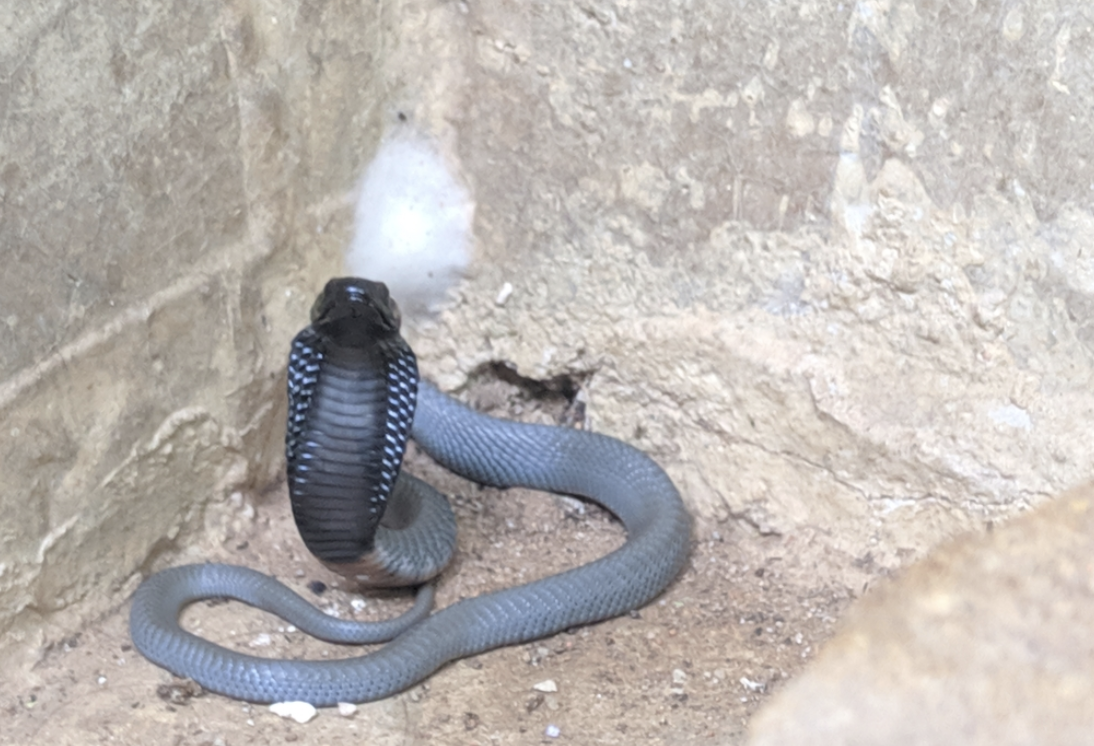
The Black-necked Spitting Cobra

We have a lot of snakes where we live and a lot of them are venomous as well. Even the non-naturalist will recognize some of the names such as the Black Mamba, Boomslang, Puff Adder, and Black-necked Spitting Cobra. I love telling people that not all of their bites are fatal but you might lose a limb. All joking aside, snakes are a threat but most if you are aware of your surroundings and take care at night or when shuffling around stationary items, you'll probably be fine.

The black-necked spitting cobra (Naja nigricollis) is a species of spitting cobra found mostly in sub-Saharan Africa. They are moderately sized snakes that can grow to a length of 1.2 to 2.2 m (3.9 to 7.2 ft) in length. They are pretty common in our area and they don't just have a clever name; they are known to stand upright and "spit" venom up to 3 meters (10 ft). If their venom enters your eyes, mouth, or open wound, you will be in trouble for sure. I've seen a few spit but I have been lucky to have been in a car each time. There used to be one that lived in a tree outside our banda but it has since moved on. 

A young one ready to spit at me in the shower

 
A year late I suspect this is the same individual.

Well, last year we found a young one in our shower and we suspected he was living underneath the structure. The shower area is full of geckos at night and we've seen a few different types of snakes in there over the years. You gotta be careful at night! 

I recently saw a black-necked spitting cobra during the day and suspected it was the same individual due to its size. After seeing the snake during the day, we noticed in the evening that a gecko was sticking out of a hole, a very unusual position for this particular species of gecko which does not normally spend time in holes. We poked the gecko and sure enough, it was not responsive. It makes sense that the snake had grabbed the gecko and prefers to consume it in the comfort and safety of its home.

Turners thick-toed Gecko has met its end


Sunday, May 28, 2023

Birdwatching at home

Bird watcher equivalent to the beer bottle on the beach
 
Repurposed grinding stone
 

We are lucky to have a covered porch area and a pair of bird baths to provide entertainment for us. The bird baths are actually repurposed grinding stones, something which is rare to see in the global north but still very common here. I am particularly fond of one in particular as I collected it on an expedition to the bush from an area that is now uninhabited. It's fascinating to contemplate its age and echoes of human history. But for now, it is filled with water and enjoyed by birds (and critters) of all types. 

The bird bathes receive more attention in the dry season when water is more scarce but it still receives visits year round. The bird baths are situated in an area about 4.5m (15 ft) from our sitting area allowing for easy viewing. We can appreciate them with the naked eye or enjoy more detail using binoculars but they are certainly close enough for easy identification when binoculars are not handy. 

I really enjoy having my coffee in the mornings and watching the different groups of birds pop in for a drink or quick bath. We've seen 225 of species at camp since we moved here with about 55 of them having been recorded each month. That means there are plenty of familiar faces while also the possibility of a rare visitor turning up. It's fun to note the behaviors and etiquette at the bird bath; Ashy Starlings come in a large group and trash the place, the African Bare-eyed Thrush bullies everyone and doesn't share, weavers overwhelm the bath but readily share with smaller birds, and on and on.

A sample of the visitors, including our resident Shikra

The bird aren't the only thing attracted to the bird baths. Toads, frogs, wasps, bees, mongooses, monitor lizards, smaller lizards and skinks, jackals, dogs, and everything else that needs water to survive occasionally find their way to the water source. It's a simple addition to our outdoor space that provides constant entertainment and wildlife sightings!

Saturday, May 27, 2023

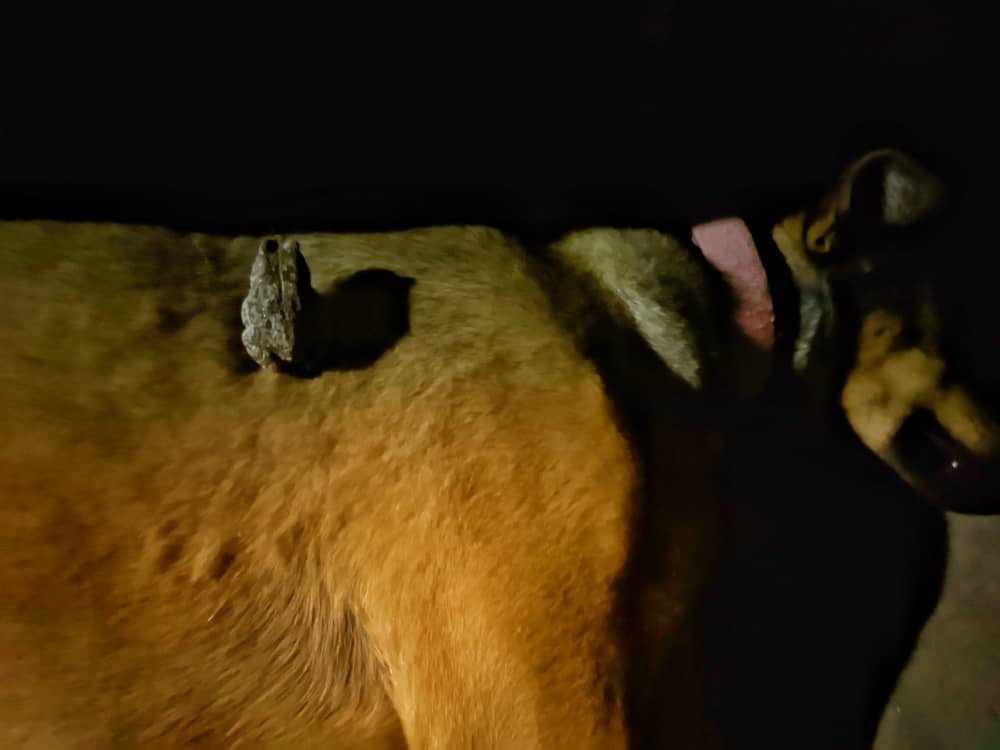
The dog and the toad friendship

We have a few dogs here at camp and they have a ton of freedom very rarely afforded to dogs in the west, or as is now en vogue to say, the global north. Our camp dogs roam free in an area of about 50,000 square meters or 12 acres. There are a few different structures scattered throughout our property but the area has a lot of wild spaces with trees, shrubs and grasses. The area surrounding us is sparsely populated with the majority of disturbed areas being fields and farms. As a result we did a significant amount of boundary training with the dogs when they were young to ensure that they could lead a life of freedom in adulthood. 

The dogs are great at barking at intruders such as bush pigs, kudu, and the occasional lion, but they are frankly very cowardly dogs. When they were young we initially had them sleeping in a large enclosure. One night a hedgehog roamed into their territory and they were petrified. They were so traumatized that the next day they didn't want to go back in! They were also terrified of a leopard tortoise the first time they saw one, much to my amusement. 

Over the years they've gotten to recognize friend from foe and although they are still cautious they are no longer terrified at every single thing. In fact, they've been able to forge friendships that I would have initially never thought possible. 

One of the more common critters in the dry season are toads. Specifically, the species named guttural toad (Sclerophrys gutturalis) are most common here. They are experts at digging shallow holes during the day and at night finding water sources to wallow in. They're one of those creatures that's kind of always around no matter the time of year. They show up in the bird baths, the residue from our bathing water, and any other random pool of water that happens to form. 

Toad in the day burrow

We recently bought a bowl for the dogs to drink water at our banda. We should have known but when we put it out the toads immediately began to gather in the night. Perhaps they liked the bowl's dimensions or the clean water but for whatever reason, we saw a concentration of toads that we had never previously seen. At one point there were five toads in the bowl with others lurking in the background. It was a little alarming to walk by and have them all simultaneously scatter. 

We wondered what the dogs would think and it turns out they don't really care. They initially looked at the toads with amusement but then later chose to dismiss them. It even reached the point where the toads would remain in the bowl while the dogs drank, though I'm not entirely sure if that's based on familiarity or a lack of awareness from our occasionally dopey dogs.

The good life, from a toads point of view.
The toads began to make themselves at home, spending more and more time on our veranda/patio space. Once again, the dogs were initially curious but then ignored them. It reached the point where the toads would potter around and literally on top of the dogs while they were sleeping. Sometimes the dogs will pop their heads up seemingly startled, only to see the toads and give a kind of, "Oh, just these guys" look before settling back down to sleep.
The toad is using him as a pillow.

Friday, May 26, 2023

End of rainy season


Mid-rainy season vs. end of dry season, same spot
 

The end of rainy season and transition to dry season is quite different than the transition from dry season to rainy. When rainy season initially arrives a deluge of rain immediately causes a flurry of grasses and leaves to appear. I've posted about this transition before and it's truly a shocking change. When the rainy season ends it's more of a gradual drying out of the area. I always feel like there is one week where you realize that instead of growing, plants are beginning to fade. Everything is still green but instead of being perky and strong, plants are subtly wilting.

I enjoy this transition period because there aren't as many biting insects as the peak rainy season but there is still a significant amount of foliage and vegetation to not have the landscape appear so naked. The mosquitos die out but there are still enough insects to keep a naturalist entertained (mainly beetles, crickets, and katydids) and although the migrant birds depart, there are still the usual suspects around with some birds trying to squeeze out a final clutch (most notably this year we had a very late season African Paradise-Flycatcher clutch). 

It won't be long before there is not a single blade of grass and the landscape appears more desert than tropics. The dry season is a tough time but the rhythm and changes of the seasons is one of my favorite aspects of life here.

Mid-rainy season vs. end of dry season, same spot


Another view

Friday, March 17, 2023

Camp hazards: Acacia thorns


Ouch.
 

Acacia trees are one of the biggest hazards of bush life. There are a variety of species but all of them have thorns in various shapes and sizes, some are hooks while others are spear shaped. Regardless of their shape, all of them can easily tear clothes, scratch faces, and pierce the bottom of even the sturdiest shoes. In the dry season the trees are dry and thus the thorns are hard and inflexible. In the rainy season as the tree retains more water the thorns can actually be flexible and although they are still sharp they are not nearly as piercing.

I spend a lot of time in flip flops and the above photo shows the dangers of this. Acacia trees shed their branches and it's common to have the ground littered with thorny branches of various sizes. They can not only pierce the shoddy flip flops but I've had them pierce the soles of my Merrell hiking shoes! The worst is when you break off the thorn trying to remove it and then you're left with an embedded thorn that only pokes you when applying a specific amount of pressure like when running or climbing stairs. 

You might notice that many of my camp clothes also have small tears and holes. These are undoubtedly from being snagged on branches which is unavoidable. It's one of the reasons I have bush clothes! It's also not uncommon to see us with scratches on our face and our arms and a tell-tale sign someone has had a bush expedition. 

It has taken some adjustment but now we are very careful when moving through the bush and I hope that we've reduced the amount of shoe-piercing and face-scratching incidents but the hazards still remain! It is one of those things that you have to experience to really take care; one brand new shirt ripped wide open, a seemingly innocuous branch that brushes your face and draws blood, or a harmless branch that pokes through your shoe leaving you hopping around on one foot. Everyone's gotta go through it to learn their lesson!

This species of acacia can seriously impale someone


Saturday, March 11, 2023

The birds nest


African Paradise Flycatcher (Terpsiphone viridis)
 

We are lucky enough to be set in a relatively wild environment and one thing we love is the birdlife. Birdwatching is a really fun hobby and one that I wish I would have taken up earlier in life but I'm happy to be in a place where I can "birdwatch" every day. Each morning we wake up to the chorus of bird calls and over breakfast we like to watch the various species of bird drink and bathe in our birdbath. Over the years we've gotten familiar with all the birds in our area and we particularly enjoy watching the families grow during breeding season. Every year our camp is littered with nests and we usually get one close to our banda. This year we had an African Paradise Flycatcher, one of my favorite camp birds and one that is not a resident. They only show up during the rainy season from November to May before moving on to other parts of Africa. 

This year one couple made a nest very close to our banda. In fact it was within perfect viewing range (see below) which was highly entertaining for our camp life. We watched the birds slowly build the nest which was truly a team effort. They build very compact small nests from twigs, feathers and whatever else they can get their beaks on. After they lay their eggs they take turns incubating and this was also a delight to watch as the defended their nest from other larger birds and smaller mammals like mongooses. After the eggs hatched they were then constantly feeding their chicks. Watching the African Paradise Flycatcher in flight is always a treat with its long streaming tail and wavy dolphin-like oscillations. With chicks to feed it is constantly hunting and in turn a constant distraction when I am working outside. 

Unfortunately this story does not have a happy ending. One morning I saw the nest was hanging loosely from the branch. I went to investigate and saw the nest was loose with no chicks in sight. I do not think they were quite ready to leave the nest and thus I think a mongoose, genet, civet or some other critter got them in the night. Mother nature can be ruthless!

You can see the table on our porch, the red circle is where the nest was.


First the eggs
Then the chicks


Sunday, February 26, 2023

Chameleon Season

Resting color.


After I've handled the above individual it turned a much darker color.

The rainy season provides a breath of life to many different species of plants and animals. One of my favorites are the chameleons. In our area there is only one species, the Flap-Necked Chameleon (Chamaeleo dilepis). During the rainy season they become much more visible and it's not uncommon to see them crossing the roads while driving. They are fascinating creatures that move with an odd gait and their famous eyes move independently of each other, adding to their weirdness. Growing up I had heard that they can change colors and camouflage themselves but this is only half true. They can range from bright green and yellow to dark brown but I wouldn't say they have camouflage abilities, at least certainly nothing like octopuses. It's still neat to see them change color though it is usually a sign that they are stressed out (which is typically from me handling them, sorry guys). What can I say, I can't help myself but to pick them up every single time that I see them. I love feeling their herky-jerky movements as they scramble up my arms and often onto my head. Contrary to many local beliefs, they are not venomous nor dangerous. Their claws can scrape and they can bite though I have never suffered a skin-piercing wound or anything close. 

One of the coolest things I've ever seen is when I was shown how to scan for them at night. My late friend and extremely knowledgeable safari guide from Zimbabwe once showed me at night how to scan vegetation for their presence. His ability to identify them was uncanny, downright scary. We'd be in the dark with a single head-torch and he'd identify tiny individuals under blades of grass. He explained that once you start looking for them and get familiar with their tell tale reflections and how they "disrupt" the normal vegetation patterns, well, then it's easy. It's a skill that I have tried to sharpen over the years but unfortunately I am usually simply wandering about, squinting at the grasses, likely passing over dozens of chameleons.

Very small

Very large.

One of the brownest ones that I have ever seen, clearly trying to blend in.


Saturday, February 4, 2023

Rainy Season: Butterflies and moths


All these photos were taken on one morning walk.

I wrote about the proliferation of caterpillars a few weeks ago and sure enough, within 10 days of that post our area was swarming with butterflies and moths. I have always appreciated butterflies and moths but never really dug into identification and learning much about them. This year seemed like a good year to learn more. I recently obtained a butterfly net which will help immensely to capture fast moving and skittish specimens. Pair that with an unprecedented volume and diversity of moths and butterflies and it would be foolish to pass up the opportunity! 

There was really a two week stretch in January/February where each day would bring different species of both moths and butterflies. During the day I would constantly stop to try and stalk different butterflies. At night from 830 to 930pm I'd be taking photos and trying to identify different species. It was really quite overwhelming to keep up with but once I started to appreciate the details and their behaviors I couldn't stop!


Sunday, January 22, 2023

Rainy season: After one month

Same landscape, commiphora grassland
 

Same area, now with water
 

It has been one month since the rains started and the area is brimming with life. It's difficult to explain the rapid change in environment but photos do a good job illustrating it visually. Aurally, the air is filled with sounds of more birds, some of them migratory while others are simply more active. Insect sounds fill the air from crickets and grasshoppers buzzing to beetles hissing. The air is no longer hot and dry but rather it's humid and heavy. Clouds hang in the air greatly diminishing the suns powerful rays. 

I often think that visitors never truly understand tropical climates until they experience both extremes of the rainy and dry season. It's truly difficult to believe that the area can make such a huge transformation but life proves to be very adaptable. In the dry season elephants dig for water, turtles bury themselves for months until the rains come, seeds lay dormant and other creatures migrate. The rain brings everything back resulting in a rich proliferation of life. 

An ephemeral pool

It was clear that a group of ungulates had passed through this grass, if you look carefully you can see the trail


Thursday, January 12, 2023

Rainy season: Caterpillars


All these were taken within 48 hours!

EDIT: Here is the follow up post "Rainy Season: Butterflies and Moths"


The rains came late this year and with it, a proliferation of caterpillars that I have never experienced before in my life. They were not only numerous but there were also a variety of different species. The sheer numbers were staggering and it felt almost absurd at some point with caterpillars falling off the trees, crawling across my laptop keyboard, and covering all the trees. There was a very short period of time where the caterpillars seemed to explode all over camp. 

Within a few days the caterpillars started making cocoons. The photos below were taking within eight hours and I was fascinated to see the caterpillars slow process into forming into a pupa. I was working at my desk throughout the day and kept checking the caterpillar to see it slowly morphing into a pupa. Not exactly the fastest moving action but still riveting! 

It was then very cool to see a week later these pupae exploding into butterflies. The most common were of the African Migrant (Catopsilia florella) and I did get to see a few emerge out, stretch their wings out, let them dry, and then depart. Metamorphosis is pretty unbelievable!

Forming into a pupa.


This photo was taken 7 hours after the initial one.
 
About a week later these Catopsilia florella (African migrant, African emigrant, or common vagrant) emerged
 
Look closely and you will see loads of caterpillars!


Monday, November 14, 2022

Seychelles fruit bat on Mafia Island


A total random and unexpected wildlife experience was staying on Chole Island, enjoying the sunset, when suddenly massive fruit bats began to fly towards us having come from across the bay. They ended up being Seychelles fruit bat or Seychelles flying fox (Pteropus seychellensis) and they were coming to the island to feed on the flowers of the Baobab trees. We were excited to follow them to a flowering tree and watch them crawl around the trees feasting on the nectar. 

It was funny because when we arrived at the hotel, the proprietor told us that there were nine different types of bats on the island. As the sunset we began to see some small bats and thought there were probably several species of the small ones. So we were shocked when we saw the gigantic ones coming over the ocean. I think we were also pretty lucky to have the trees flowering now giving the bats an ample food source.


Mafia Island: Snorkeling in Chole Bay


A look out into the waters, very inviting!
 

Snorkeling in Mafia Island is the best I have experienced in Tanzania. One of the more popular places is Chole Bay. Chole Bay is within Mafia Island Marine Park a short boat ride away from the mainland. There are a series of rock islands and reefs at the mouth of the bay that make for fantastic snorkeling. The reefs are healthy and there is a nice current that provides a kind of underwater moving walkway. 

We ended up snorkeling in two different spots and at the second spot we were lucky enough to see a sea turtle. It was swimming along the surface and taking in some air but was not thrilled at our presence. It went down to the bottom of the ocean and swam away but we got to view it as it glided away.

Saturday, November 12, 2022

Whale sharks in Mafia Island


Looming below...

The first time I went to Mafia (Trip I) I had an amazing time swimming with the whale sharks. They had not been the primary motivation for the trip so I was pleasantly surprised by the experience. However, the weather during my previous trip was generally rainy and cloudy and my other half did not travel with me and as a result I was looking forward to another trip.

Overall the whale shark viewing experience in Mafia Island is very well run. We were out on the water by 730am and there were not very many boats. At the peak I think there were probably five total boats with each carrying around six people. I think there some level of communication and coordination between the lodges in an effort to consolidate all the guests into fewer boats. I was also surprised at how few people actually swam alongside the whale sharks. Our guides dropped us in perfect position but many people seemed to be either weak swimmers or unfamiliar with the snorkel gear. As a result they still would have gotten an intimate view when the whale sharks passed but I think swimming alongside them is ideal. I was not complaining as I in the end had the whale sharks nearly all to myself!

We were lucky to see a few individuals, including one very large one around. There were some views in rather murky water while other sightings were in shallower water with better visibility. Our guys did an awesome job of dropping us in the path of the whale sharks and we even had some nice views of them coming to the top of the water to feed. It's such a nice activity though we were really lucky to have such great sightings. 


Wednesday, August 31, 2022

Flora and Fauna: Acacia–Commiphora bushlands and thickets


Sunset over the wooded grassland.

The dry season here can be extremely harsh. The habitat is commonly referred to as Acacia–Commiphora bushlands and thicket. Species of Acacia and Commiphora dominate the landscape and although they vary, words that come to mind describing the habitat are words like, "robust, harsh, tough, and gnarly". The dry season forces trees to adapt and they do not just adapt to the weather. Elephants and other wildlife frequently consume the bark and even the trunks of trees in a search for moisture. Most of the species are very slow growing, full of thorns or spines, and are generally unfriendly! 

I have personally grown to love the environment though in the dry season one must start and finish excursions early in the day. In stark contrast to the rainy season, where there are critters everywhere, vast areas in the dry season can appear completely lifeless. Still, if you keep your eyes peeled you can see some pretty cool stuff.  It's exciting to find new plants, insects and other flora and fauna that have adapted to flowering, breeding, or other activities during the harshest time of the year.

Wooded grassland, these trees are neither Acacia nor Commiphoras but you can see the have similar features.

A burned grassland in a commiphora woodland.

This is one of my favorite flowering trees, Sesamothamnus busseanus. It flowers in the dry season and these white flowers stand out. 

Commiphora woodland. They are very slow growing trees.

Acacia trees on a dried riverbank.