Showing posts with label Mbeya Region. Show all posts

Friday, October 21, 2022

Ngosi Crater lake north rim


The lake
 

We had visited Ngosi Crater Lake on a previous trip (Trip I) but had accessed it from the southern entrance. On a previous trip to Mbeya we had tried but failed to reach the newer northern point. Our failure was due to the steep and wet roads during rainy season. Although the road was well signed, the road was full of deep erosion, sticky mud, and poor visibility. We ended up turning around so I was pleased to complete the journey today. 

The road has clearly received some maintenance but there are still some very steep sections. The views over the agriculture dominated rolling hills are spectacular. It took less than a half hour from the main road to reach to the entrance, which wasn't much more than an old signpost fixed at a trailhead. 

We parked the car and enjoyed the short 2.2 km (1.4 miles) hike to the crater rim. The path took us through open grassland and then a short bit through montane forest. It was a very gradual climb and l would recommend the hike to just about anyone of any fitness level and age. 

There were some cement picnic benches and a collapsed viewing platform all with stunning views. There appeared to be a trail down to the lake but it was incredibly steep so I only peaked down the ravine. 

I'm happy to see another access point to the crater lake. It's a great day trip activity from Mbeya and maybe one day I'll have the strength to walk down to the waters edge!

A nice little forest patch


Thursday, October 20, 2022

Mt. Rungwe (Trip III)


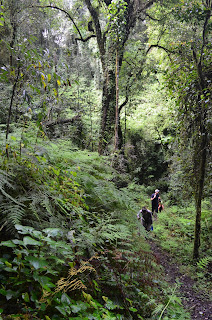
Beautiful forest

Mt. Rungwe is a burly hike and this expedition proved no less challenging than our previous hikes (Trip I, Trip II). 

The day did not begin auspiciously when I tried to take a shortcut from Mbeya and we almost ended up in Malawi. Literally. I had a feeling that the back road was heading in the wrong direction. I stopped to ask a random woman on the road where the road headed. She casually replied Malawi and I asked her if the road to Tukyu (nearest city to Mt. Rungwe) was near and she immediately looked concerned and told me it was far. Very far. Welp, we turned around and then realized that the original shortcut that we wanted to take was closed due bridge repairs. We ended up picking up a random old man to help direct us to the turnoff. He disembarked before but gave us explicit instructions. We still missed it and ended up having to ask yet another person for directions. We finally located the tiny path and our mood lightened as we took in expansive views of the landscape. The road was clearly used more frequently as a footpath or for motorcycles. We enjoyed the ride down to the main road as we realized that we would indeed make the hike today.

However, tjos meant we got a late start and we really pushed it to make it to the top. We started the climb at 10:30am. We managed to make the climb in 4 hours and 51 minutes and descended in about three hours but we were pushing it hard. One way is only 6.4km (about 4 miles) but the altitude gain is 1,340m (4,400 ft). There are some extremely steep sections and towards the top the altitude can really affect the body. 

We had an incredible hike with great sightings of Colobus, Kipunji, and Blue Monkeys. We were casually birdwatching but saw a Bar-tailed Trogon, Red-faced Crimsonwing, and Silvery-cheeked Hornbills. The weather was great and we got to enjoy some time on the summit without fierce wind. 

I was disappointed to see the rustic bungalows were torn down at the new campsite. We met a crew that was building a new toilet which I suppose is a welcome upgrade from the simple drop toilet. The "second campsite" appears to have been completely overgrown and even the path to the toilet is obscured. There was a lot more litter on the trail than our previous excursions which I suppose means it's being used but I wish it was kept a little cleaner though it wasn't completely trashed or anything. 

The hike is not for the faint-hearted and unfit; it requires a decent level of fitness and the rapid gain in elevation can be tough. I love how the trail winds through different environments and the peak has some fantastic views that make it worth it!

Almost to the top


In the bamboo zone

Sunday, September 20, 2020

Lake Nyasa (Lake Malawi): Trip II


Enjoying a walk in the evening.

In what seems like a perfect pairing, we once again hiked Mt. Rungwe en route to Matema Beach (Trip I). It's one of the closer large bodies of water to us and the Livingstone Mountains provide a beautiful backdrop to the massive lake. Having grown up on a Great Lake in Wisconsin in the USA, being next to a massive body of water is comforting. The only unfortunate thing is that the lake likely has Schistosomiasis, an acute and chronic parasitic disease. Although it can be treated, it's still not ideal to get. Reliable information on its presence is sparse but it appears the lake was free of Shicstosomiasis in the 80s but there have been rising numbers of cases, especially in the southern part of the lake. With that being said, we absolutely swam in the cool and clear lake. 

Matema is a strange village in that the agricultural activities sprawl in every direction but the dwellings and village proper are very densely arranged. There is a roundabout that serves as the nexus of activity in close proximity to the market and Lutheran Center. There is local beach access hosting a variety activities from fishing to bathing to washing. People are also just hanging out on the beach as well with a good number of people coming out in the evenings. 

On our previous visit we did not go snorkeling, falsely believing that snorkeling in a fresh water lake would be lackluster. This time around we arranged to go to the snorkeling spot and we were in disbelief at how plentiful and varied the fish were. We knew that the lake was famous for Cichlids and that over 600 of the 1,000 species of fish in the lake were endemic, but we were not prepared for a variety of fish that rivaled the quality of snorkeling in many places in Zanzibar. There was a rocky area where the fish fed off the algae and plankton, basically serving as a "rock reef". The water was extremely clear and the only perilous part of the journey was the rickety boat ride taking in water at an alarming rate though one can make arrangements with a more lake-worthy vessel if one chooses to do so. 

The rest of the time we spent hiking around, watching the Trumpeter Hornbills come in to roost at night, and swimming in the lake. At night the sky is clear with the milky way clearly shining. Many fisherman were also out at night using lights; I counted 75 boats around 10pm. I'm sure there were many more out there further out in the lake.


Some of the riverine vegetation with hippos nearby.

Snorkeling spot.

Boat ride to the snorkeling.


Monday, December 30, 2019

Ngosi Crater Lake

Great viewpoint. I'm sure if it's sunny the water is an even more stunning mix of blues and greens
Ngosi Crater Lake (also spelled Ngozi) is a place we've always talked about going to but never got around to it. The picturesque and easily accessible lake is a top attraction for the south. It's only about an hour from Mbeya town and theoretically can be reached from two different access points. There seems to have been a recent investment in the attraction and we saw a new sign post just south of Uyole. Unfortunately the pouring rain and previous days rains made the road impassible. It was a beautiful drive along a narrow ridge surrounded by verdant farms. I imagine the climb made its way to the northern rim and likely a great viewpoint.

When we turned around we went to the more well known turn off to the lake past the village of Isongole, about an hour from Mbeya. We were once again met with some muddy roads and managed to get stuck in a mud soup but wriggled our way out. We were not to be deterred and continued on though the lack of tire tracks indicated it was not the right season to make the trek.

In the end we made it to the trailhead in a lush piece of forest. We were pleasantly surprised at how dense the forest was so close to the road and farms. There was an obvious trail that led up to the rim of the crater with a beautiful viewpoint. The hike only took about an hour or so at a leisurely pace.  There was an extremely steep path that led down to the lake but after a long weekend of hiking I was not very enthusiastic about the climb. We enjoyed the views and then took our time on the trail back stopping to examine all the fungi and birds inhabiting the forest. We were pleased to see some Colobus monkeys as well. I'm hoping in the future they will link the two view points by a crater rim trail, it'd be quite the hike!

Reaching the trailhead we had evidence of being stuck in the mud on our car.

Hiking in the forest
Amazing fungi. I did not consume them.

Sunday, December 29, 2019

Lake Rukwa


Stroll on the beach
I love an “off the beaten path” excursion and Lake Rukwa offered just that. For a lake its size it is pretty low profile and certainly not a tourist draw. Known for its immense crocodile population, Lake Rukwa is an endorheic lake, meaning it retains its water and has no outflow to rivers or the ocean. This means historically it has fluctuated greatly in size. Some years it is less than 50km long, currently it is around 150km long meaning it's around the 25th largest lake in the world!

It’s easier to access via the west side of the lake but since we were in the area of the south we decided to try to reach the shores of the south. There wasn’t much information we had on it other than that it did seem possible to reach the lake from the south. We were slightly discouraged by the recent heavy rains as most of the roads indicated we’d go through low lying land adjacent to the lake, most of which would probably be flooded. Our fears were realized when the first two options for reaching the lake were not passable (Totoe and Mwambani). It was getting pretty late in the day but decided to press on to the Mbagala. We passed the unusually large and developed town of Mkwajuni and then through Saza. We passed a huge mine and along the road there seemed to be several "artisanal" mines.

The road was extremely muddy but we finally found a road down to Mbagala. It seemed we were up on an escarpment so the road went straight down a hillside to the lake shore. It was slippery but we made it and had time to hike the shores. Lake Rukwa is very famous for the crocodiles (man eaters!) so we were very cautious. We asked one local fisherman if there were crocs and he said no but then we asked a small child and he said there were many but, "If you see them you can just run". Uh, yeah, we'll just be very cautious and stay to open areas.

The walk along the shore was beautiful and I imagine another day it would be great to charter a boat and go along the coast. There was evidence of heavy fishing (fisherman have a local buoy design with plastic bottles) but the lake shores seemed sparsely populated. Very unfortunate that I wasn't brave enough to swim, but I am not sure I could "outrun" a croc...
Overlooking the east.

View to the west

Nice forested area to the north

Saturday, December 28, 2019

Flamingo Lake


Walking to the lake
One our way to Lake Rukwa we passed by a seasonal lake that at this time of year is full of water. Located a few kilometers off the main road, Flamingo Lake is easy accessible and great for birdwatching. I imagine it is picturesque if there aren’t clouds obscuring the Mbeya mountain range as well.

We found a questionable path down to the lake and parked the car near the shore. There were dozens of tiny frogs that I assume have recently hatched with the rains. True to its name, the lake had a nice group of Lesser Flamingos as well as pelicans, plovers, gulls and a lone Spoonbill. There were some herds of cattle grazing around the lake and some curious kids came to greet us and follow close behind. There was a neat little sandbank that cut into the lake giving us excellent views of some of the birds. It was a great break from the drive and the overcast day provided some cloud cover for a nice stroll, an of course I am always happy to see a group of Lesser Flamingos.
Sandbank.
Neat little frogs everywhere

Friday, December 27, 2019

Mt. Mbeya hike

Overlooking the valley
While in Mbeya we really wanted to do some trekking and Mt. Mbeya (2,565m/8,415 ft) was the natural option. Mbeya is located in rolling hills with the Mbeya mountain range to the north. The range is formed by the  joining of the eastern Gregory Rift and western Albertine Rift valleys

We are always averse to taking a guide if only for the reason that we love taking our time and moving at our own pace. It’s not that we’re unfriendly people but a critical aspect we love about hiking is the solitude. Many guides in less touristy areas sometimes overdo the guiding and fail to read that we want to just chill on our walk. It doesn’t help that the typical tourist to Tanzania actually enjoys more interaction with a local guide so I’m sure they perceive interactions with tourists along the trail as a net positive.

However, it became increasingly clear that the trail up Mt. Mbeya is not well marked and it would be wise if someone would show us the way. Through some normal chit-chat with locals I recruited an eager older gentleman who said he could show us the way. He was just a normal local farmer and we generally enjoyed his company up the mountain.

We started out from a coffee farm located as close as one can drive to the south. There is another access point to bypass the majority of the hike from a small village in the north but we decided that we had the time to hike and wanted to take advantage of it. The first part of the hike wound through farmland rather steeply. The majority of the forest had long been cleared but we passed through a few bird rich fragments of forest. The path was very steep and we passed maybe five different groups of people that were either living deep up the mountain or coming from the village on the other side. At one point we passed a caravan of people with donkeys loaded with mangoes and they explained they were a type of mango that wasn’t available on the other side.

The path continued steeply until we reached a sort of plateu where we could see the alternative starting point village on the other side. Some cows grazed on the steep grassy hillside and we began to climb. We eventually started to snake around the side of the mountain on a very narrow path though far less disturbed than the previous trail.

As we neared the peak the views were lovely. The clouds came below us and around us. There had been frequent rains the previous days so the trail was very slippery. As we reached the final ascent the trail became unclear and we were basically scrambling up the slippery hillside using small clumps of grass as footing. We made it to a nice vista and decided it was probably not worth it to continue and headed back down.

The trail was very steep and although it lacked the beauty of having pristine forests, the views overlooking the valley were spectacular. Even if one starts at the alternative starting point the trail is still very steep although it would allow you to really take your time. We’ll hopefully come back again and perhaps summit the top though the trade off between sore knees and good view is one to consider!
Amazing endemic chameleon that we were lucky enough to spot.
Clouds coming through
The beginning of the hike, Mt. Mbeya peak.
View to the north, above the clouds.

Thursday, December 26, 2019

Mbeya: Utengule Coffee Lodge


Not my picture but could have taken one just like it!
Tanzania has a few farms that have converted or added rural retreat hotels (Simba Farm, Kisolanza Farm). We typically enjoy these places for their quiet, delicious food, and nice birdwatching. Utengule Coffee Lodge was no different though it was much larger than the other farmhouses that we’ve visited.

Set up in the mountains at the base of Mt. Mbeya, the lodge is located about 20 minutes outside of Mbeya proper. It’s a very large property with a main lodge with nearby traditional rooms and then a separate area with standalone “bungalows” (houses) that can either be fully furnished and equipped or have bare bones facilities aimed towards campers and overlanders. Due to lack of availability of the bungalows one night, we stayed one night in a proper room and then two nights in the bungalows. The main property is beautifully manicured with fantastic views into the valley. There is a swimming pool that is frequented by day visitors along with a tennis court, TV viewing banda, and a main lodge with a restaurant. The rooms are quite nice though they are all housed in a large building which gives the feel of a traditional hotel. We much preferred the bungalows which suit our style of isolation much more. The bungalows are really standalone houses with several rooms and a full kitchen. They are spread out in a nicely landscaped area which is conducive to bird watching.

The farm itself offers coffee tours (we heard they’re great) and delicious food. The menu has a mix of traditional food as well as western food. Everything was very fresh and good value. There are some hiking trails behind the main area through some nice woodland if one cares to have an afternoon stroll.

We loved the setting of the lodge and bungalows are a perfect type of accommodation for us. We look forward to coming back and using it as a base for Mbeya activities or just chilling out for a long weekend.

Sunday, April 1, 2018

Lake Nyasa (Lake Malawi)

River pool entering into the lake
Lake Nyasa (also known as Lake Malawi) is Africa's third largest lake around 550km long and 75km wide. Bordered by Tanzania, Malawi and Mozambique, the Tanzanian side is rimmed to the east by the Livingstone Mountains whose jagged green slopes form a stunning backdrop as they drop dramatically into the lake. The small village of Matema served as our base as we explored the area. A perfect spot to relax, Matema has a nice beach with a variety of lodging options for everyone from the backpacker to those who want something a little classier.

After the nice hike in Mt. Rungwe we were pretty tired and although several touts advertised their services for a waterfall hike, we all agreed we'd be better off hanging out at the beach and maybe going to explore a nearby river for a bird walk. After a lazy morning we headed down the beach and  trekked until the mouth of a river. There we were surprised to see a hippo about 10m off the shore in the lake. It bobbed up and down while emitting its guttural vocalizations. We had been warned to be careful at the mouths of the river as hippos and crocodiles hid among the reeds. At this point we chatted up a local fisherman that just happened to be pulling up to the shore. He showed us his catch and was in dismay at only catching three small fish. We decided he might be the perfect guy to show us around and he agreed to show us around the area for the equivalent of $1. He led us around the river into a mosaic of agriculture, grazing, and swampland. It was cloudy that day so the temperature was agreeable and we enjoyed a relaxed walk. We even passed through our “guide's” house and he showed us some of the different plants that he grew. The area was extremely lush and the farmers appeared to be growing a diverse set of crops such as banana, pineapple, cocoa, banana, maize, and cassava. It was a cool experience and the fisherman (named Mpoki) was very candid explaining different features of the area. He was perplexed why we wanted to stop and look at all the birds but didn't seem to mind as we plodded along.

In the evening we relaxed at the beach and went for a swim with a delicious fish dinner rounding out the day. In the evening we went down to the beach and watched incredible lightening storms pass across the lake until they finally reached our side of the lake, which sent us scurrying back to our rooms.

Matema was a great spot to relax and although it's just a huge lake, the people and the rhythm mirror the feel of a coastal town. We're looking forward to our next visit and maybe then we'll have the energy for the waterfall hike.
Livingstone Mountains in the background

Selfies on the beach

Saturday, March 31, 2018

Mt. Rungwe

Campsite
I hadn't actually heard of Mt. Rungwe until our friends suggested climbing it en route to Lake Nyasa/Lake Malawi for the Easter Holiday. The 2960m dormant volcano is located at the point where the eastern and western arms of the Rift Valley meet surrounded by lush forest and the picturesque rolling hills of the southern highlands.

As with many of the non-traditional tourist activities, information was hard to find though we lucked out when we heard one of our friends had recently hiked the mountain. We got in touch with the Forestry Office and arranged to pay our fees in Tukuyu and then meet a local ranger by the highway to show us the road to the forest. When we arrived at the Forestry Office we found out the forestry officer had gone to school with one of my co-workers! She was very friendly and explained the logistics of the hike and facilities available. We agreed to go to the campsite just inside the forestry reserve border, spend the night and then hike the next day.

The road from the highway to the trail-head wound through a diverse maze of crops. Rains had made the road difficult to pass in some places and it took about an hour to reach the trail-head. We met a crew of guys building a new office, which made us feel better about leaving the car there. We then hiked about 15 minutes into the forest and found the campsite which consisted of a few covered areas and a basic pit toilet. A small river passed to one side of the camp and we were greeted with a group of the endemic Kipunji Monkeys passing through feeding on fruiting trees. We set up camp and enjoyed a short walk before dark. In the evening we were excited to see a few galagos passing through camp, and I'm always excited to put our spotlight to good use!

The next morning we set off early in damp and cold conditions. The trail was well cleared and marked and the first part of the hike was relatively flat with a few steep sections. The canopy and forest was a bit disturbed but massive specimens of various types of trees remained. Along with the Kipunji Monkeys we also saw Angola Black and White Colobus and Blue Monkey groups. It was probably the highest concentration of monkeys that we've seen hiking the forests of Tanzania! The sun even began to peak through the clouds illuminating the moisture and green of the forest.

After a few hours we reached a second campsite with a simple toilet but no water source. We then crossed a steep gully and from then on the trail was quite steep. Unfortunately the weather also started to turn, though we decided to push on as far as we could. We eventually reached a grassy ridge-line that gave way to a bamboo forest. At this point the rain began to come down accompanied by thunder and lightening, so we decided to turn around. It was chilly up there and the slippery steep descent was a challenge with every member of our group taking a fall in the mud on the way down.

When we nearly reached the first camp the rain had slowed down and we met a local guide with two Asian tourists. We were shocked to see them starting their climb at that hour (around 1pm) though their guide seemed confident that there was no longer any rain towards the top. The tourists looked cheerful so we wished them luck and then made our way back to camp.

The hike was great and the accessibility and presence of walking trails was a huge bonus. We've visited several forest reserves in Tanzania and it's not always easy to find trails and figure out how to get there. Although the forest wasn't the most pristine we've seen, it was still a beautiful montane forest. Even the presence of the rain isn't as bad when you realize how much it fits the ecosystem and the vibe of a damp highland forest is one of my favorite natural settings. As long as you have a clean pair of clothes at your campsite or car, one can enjoy the rain!
Great light in the forest. 
Hiking up the trail


Saturday, December 16, 2017

Ruaha National Park: African Wild Dogs

Photo credit to our friend who took these great pics!
One of the most difficult and sought after mammals to view in Tanzania is the African Wild Dog. Not only is it endangered with very few remaining in the wild but its movements are also unpredictable. There aren't any spots that have a high chance of viewing year round (unlike, for example, the rhino) and seeing them often comes down to luck. We are lucky because Ruaha National Park is one of the places with a relatively high chance of seeing them, especially when they are denning.

There are only around 6,000 African Wild Dogs left in the wild with habitat destruction and disease largely contributing to their decline. They need a huge territory and with habitat loss much of their historical range is now fragmented. There were a few that were equipped with satellite collars and their movements took them throughout Tanzania thousands of kilometers before the collars battery died. As a result, they can be sighted in strange places and usually only for a short duration of time. One was even seen near the peak of Mt. Kilimanjaro!

We had heard there were some African Wild Dogs in Ruaha National Park and decided to take a trip to try to see them. We spend the night and woke up at 5:30 to try to take advantage of the first light as the dogs are most active in the mornings and evenings. We drove to an area of the park where they had been seen and I was a bit discouraged because the area was dense with bush and thus we couldn't scan very far. Right when I was giving up I saw a few dogs moving on the side of the road.

I couldn't believe our luck. The dogs, in true canine behavior, approached us with curiosity and got within 10m of our car! We watched them play for about a half hour before we heard a lion roaring quite close! The dogs took notice and casually moved back towards a hill in denser bush. We were in awe to have such an intimate time with the dogs and watching them relax and play in the morning all alone is one of the top wildlife experiences I've had in Tanzania!

Each dog has a unique coat pattern


Chillin in the grass. 

I was in shock as Ana tries to get her phone out for a quick picture.